Bambu Lab X2D: What It Is, What's New, and Who Should Buy It
Published · Full spec page →
Short version
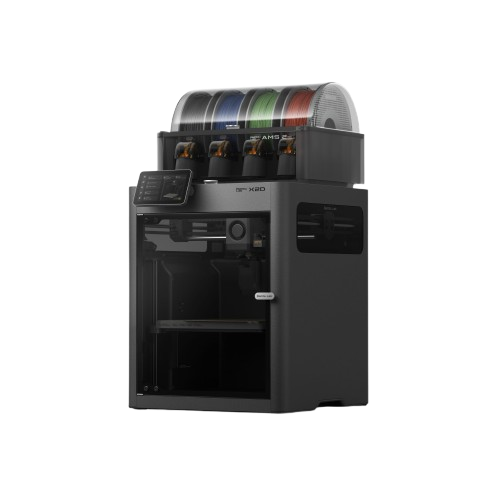
The X2D is a $649 enclosed CoreXY with dual nozzles and an active 65°C chamber. It slots between the P2S ($549) and the H-series, directly replacing the X1 Carbon in the lineup at $550 less. If you were considering the X1C, buy the X2D instead. If the P2S was already enough, it still is.
The basics
Bambu Lab announced the X2D on April 14, 2026. It starts at $649 for the base unit and $899 for the Combo, which includes an AMS 2 Pro. In Europe the base model comes in at €629 / £569.
The headline features are an active chamber heater (up to 65°C), a dual-nozzle system with independent extruder types, and a 256 × 256 × 260mm build volume. Weight is 16.25 kg. The printer uses three-stage filtration: a G3 pre-filter, an H12 HEPA filter, and a coconut-shell activated carbon layer. Noise is rated below 50 dB.
The dual-nozzle setup, explained properly
The X2D has two separate hot ends with two different extruder configurations, and the distinction matters.
The left nozzle (the primary one you'll use for your main material) uses a direct drive extruder with the motor mounted at the toolhead. This is the faster, more capable of the two: it handles the full material range up to 300°C and runs at higher speeds. The right nozzle uses a Bowden configuration with its motor mounted at the rear of the printer, which is lighter in the toolhead but limits that nozzle's maximum speed to 200 mm/s and narrows its material compatibility.
In practice the right nozzle is designed for support material: PVA, BVOH, or other dissolvable or breakaway filaments that don't require high speed or extreme temperatures. Running a dedicated support nozzle means no purge tower for nozzle-switch waste and cleaner support interfaces. Nozzle switching is handled by a gear-and-trigger mechanism in the toolhead rather than an additional motor, keeping the toolhead mass low.
One thing worth noting: in dual-nozzle mode the build area shrinks from 256 × 256 × 260mm to 235.5 × 256 × 256mm, because both nozzles need to reach the full print area and the offset between them costs usable X space. For most prints this is irrelevant. If you're printing right at the edge of the build envelope, plan accordingly.
Active chamber: why it matters
The X2D actively heats its enclosure to up to 65°C. This is the same chamber temperature the H-series reaches, and it's meaningfully different from what printers like the P2S or X1C offer. Those machines have passive enclosures that warm up as a side effect of printing, reaching somewhere around 45–50°C in practice depending on ambient temperature and how long the print runs. The X2D holds 65°C actively regardless of the room.
What this unlocks is reliable ABS, ASA, and Nylon printing without warping on large parts. A passive chamber in a cold room or an air-conditioned space can drop below the threshold that keeps parts from delaminating. An active chamber removes that variable. It's a genuine engineering improvement, not a spec-sheet number.
The 300°C nozzle limit still applies, so PA-CF, PC, and other high-temperature engineering polymers that need 310°C+ are off the table. For those, the H2S at $1,249 remains the entry point.
What changed versus the X1 Carbon
The X1C launched in 2022 at $1,199 and was Bambu's flagship until the H-series arrived. The X2D supersedes it at $649 and beats it on almost every hardware spec: active chamber versus passive, dual nozzle versus single, 25-color AMS 2 Pro support versus 16-color original AMS, and two AI cameras versus one. The acceleration figure (20,000 mm/s²) is the same on both.
The one thing the X1C retains is its Lidar sensor, which performs real-time first-layer scanning and flow calibration. The X2D uses camera-based calibration instead. The Vision Encoder (an optional add-on, not included in the base price) brings 50-micron motion accuracy to the X2D for users who need it. Whether camera-based calibration is a meaningful step down from Lidar in practice depends on your workflow. For the majority of hobby and prosumer use, the gap won't be noticeable.
Where it fits in the lineup
The X2D is priced $100 above the P2S. The P2S is faster (600 mm/s on its main extruder vs 500 mm/s on the X2D's primary nozzle) and has no dual-nozzle build volume penalty. The X2D has the active chamber, dual nozzle, and 25-color AMS support. For most users who need an enclosed printer, the X2D's feature set is the better buy at $100 more. The P2S still makes sense if raw print speed is the priority.
At the top end, the H2S ($1,199) adds a 350°C nozzle, 1000 mm/s speed, 20,000 mm/s² acceleration, and a substantially larger 340 × 320 × 340mm build volume. The X2D undercuts it by $600 and is meaningfully lighter (16.25 kg vs 30 kg), which matters if you need to move it.
| Feature | P2S | X2D | X1C | H2S |
|---|---|---|---|---|
| Price | $549 | $649 | $1,199 | $1,249 |
| Chamber heating | Passive ~50°C | Active 65°C | Passive ~45°C | Active 65°C |
| Dual nozzle | No | Yes (DD + Bowden) | No | No |
| Max nozzle temp | 300°C | 300°C | 300°C | 350°C |
| Max speed (main) | 600 mm/s | 500 mm/s | 500 mm/s | 1000 mm/s |
| Lidar | No | No | Yes | No |
| AMS colors | 16 (AMS 2.0) | 25 (AMS 2 Pro) | 16 (AMS) | 16 (AMS 2.0) |
| Weight | ~17 kg | 16.25 kg | 17.8 kg | ~32 kg |
Is it actually worth buying?
If you were planning to buy an X1C, buy the X2D. You get a better machine for less money. The only real trade-off is Lidar, and that's a meaningful loss only for users who depend on its flow calibration and unattended overnight production. For everyone else, the X2D's camera-based system covers the practical needs.
If you were looking at the P2S, the decision is tighter. The $100 jump to the X2D buys active chamber heating and a support nozzle, both of which are genuinely useful features. If you print ABS or ASA regularly, or want clean support removal without a purge tower, it's worth it. If you only print PLA and PETG and don't need any of that, the P2S is still fine.
The Combo at $899 (includes AMS 2 Pro) is the better buy over the base if multi-color or multi-material is on your roadmap. Buying the AMS 2 Pro separately later costs more.