Clogged Nozzle
Follow the steps in order. Most clogs clear by step 2 or 3.
Is it a nozzle clog or an AMS feeding issue?
Both look the same: no filament coming out. Before cleaning the nozzle, isolate the problem.
- Disconnect the AMS from the printer (unplug the PTFE tube at the back of the machine).
- Heat the nozzle to printing temperature for your filament.
- Manually push filament into the extruder from the top.
- If filament flows freely out of the nozzle → AMS was the problem, not the nozzle. See the AMS guide.
- If you feel strong resistance or nothing comes out → you have a nozzle/hotend clog. Continue below.
Purge at 280–300 °C
High temperature softens and pushes out most clogs caused by carbonized residue or a partial blockage.
- On the printer touchscreen: go to Temperature → Nozzle and set it to 280 °C.
- Once it reaches 240 °C, start pressing Extrude repeatedly.
- At 280 °C, keep extruding continuously for 30–60 seconds.
- Increase to 300 °C if filament still won't flow. (300 °C is the safe maximum for standard Bambu hotends.)
Works best on: PLA residue, PETG carbonization, minor partial blockages.
Use the cleaning needle
Bambu Lab includes a cleaning needle with every printer. It physically breaks up debris inside the nozzle tip.
- Keep the nozzle hot at printing temperature (or higher, up to 280 °C).
- Insert the needle into the nozzle opening from below, using gentle in-and-out strokes.
- For a 0.4 mm nozzle: use a needle no thicker than 0.35 mm. Using a thicker needle risks damaging the nozzle.
- After a few strokes, press Extrude to flush debris out. Repeat 3–5 times.
Cold pull (Atomic Pull)
The cold pull physically drags clog debris out of the nozzle. It is the most reliable cleaning method. Repeat 3–5 times until the pulled filament comes out clean with no dark specks.
- Remove the PTFE tube at the top of the extruder by pressing the fitting and pulling the tube out.
- Set nozzle temperature to 250 °C.
- Push a length of PLA or Nylon (best materials for cold pull) into the extruder manually until filament flows from the nozzle tip.
- Lower the temperature to the pull temperature for your material (see table below). Keep pressing Extrude every 2–3 seconds while it cools to maintain pressure.
- At pull temperature: grip the filament firmly and pull it out in one steady, confident motion. You should feel resistance, then a pop.
- Inspect the tip: a correct cold pull shows a cone-shaped end (imprint of the nozzle interior). Dark spots or debris = clog material was removed.
- Repeat until the pulled filament tip is clean and translucent.
| PLA | Pull at 70–90 °C |
| PETG | Pull at 100–120 °C |
| ABS / ASA | Pull at 110–130 °C |
| Nylon / PA | Pull at 120–140 °C |
| PC | Pull at 130–150 °C |
Tip: If the filament breaks instead of pulling cleanly → temperature is too low. If it slides out easily without resistance → temperature is still too high. Adjust by ±5 °C.
A1 / A1 Mini: Remove the snap-fit hotend from the toolhead, feed filament in from above, let it cool to pull temperature, then pull.
H2S / H2D / P2S: Use Touchscreen → Toolbox → Nozzle Cold Pull Maintenance for a guided automated process.
Replace the hotend assembly
If multiple cold pulls and needle cleaning haven't cleared the clog, replacement is the fastest and most reliable fix. A replacement hotend for Bambu costs €11–16 and takes 3–5 minutes to swap.
Bambu hotends are integrated assemblies (nozzle + heatblock in one unit), not screw-in nozzles like other brands. You replace the whole assembly, not just the nozzle tip.
On the X1C, P1S, and P1P, remove 2 M3 screws and 2 connectors. The swap takes 3–5 minutes, and all three models use the same hotend format. On the A1 and A1 Mini, it's a snap-off quick-swap system: no tools needed, under 60 seconds.
The community rule of thumb: if you've spent more than 30 minutes troubleshooting a clog, just replace the hotend. The time saved is worth more than the part cost.
Less common causes
Heat creep happens when heat from the print chamber travels up into the heatbreak zone, softening filament before it reaches the melt zone. The result looks like a nozzle clog but is actually a blockage in the heatbreak. Fix: On X1C and P1S, open the front door and/or remove the top glass cover when printing PLA or TPU. The cooler ambient temperature prevents heat creep. This is Bambu's own recommendation.
Silk PLA leaves particularly stubborn residue. After any silk print, flush with 50–100 mm of regular PLA before switching materials.
PETG carbonizes quickly during pauses or failed prints. If you cancel a print, unload immediately before the material burns in the nozzle.
Carbon Fiber / Glass Fiber filaments must never be run through a 0.2 mm nozzle, as the particles are physically larger than the opening. Use 0.4 mm minimum for Bambu CF filaments, 0.6 mm recommended for all other CF/GF.
TPU jams when retraction is too high. The flexible filament buckles in the heatbreak zone instead of retracting. Keep retraction at 0–0.8 mm and always print from the external spool, not the AMS.
Hardened steel nozzles with standard PLA/PETG: 500–1,000+ hours. With CF/GF abrasives: 200–500 hours. Stainless steel with any abrasive material: replace immediately with hardened steel. Glow-in-the-dark, metal fill, sparkle filaments are especially abrasive: 50–200 hours on hardened steel. Signs of wear: under-extrusion that calibration can't fix, visibly rounded or oval nozzle tip.
Every 50–100 hours: inspect nozzle tip and silicone sock. Every 200–300 hours: do a preventive cold pull. Every 200–300 hours: check PTFE tube for discoloration or kinks. After any material change between incompatible families (e.g., PA → PLA): purge 50–100 mm of new material before starting the next print.
Nothing worked?
Post your case in the community forum, photos help a lot, and we answer within a day. Or try the interactive troubleshooter.
Nozzle cleared!
Bookmark this page for next time.
Tools that fix this
The gear that clears a clog fastest.
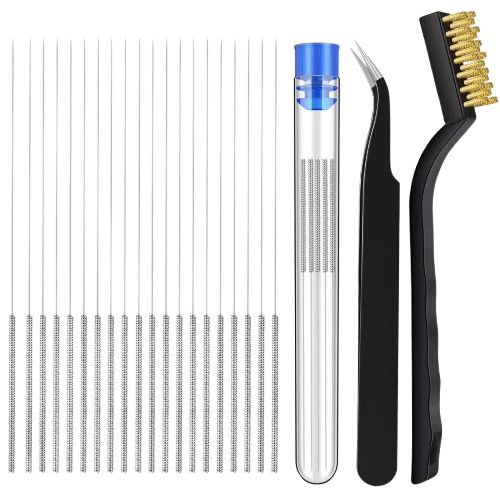
Includes the sub-0.35 mm needles and drill bits you need to physically break up debris inside the nozzle tip.
Amazon →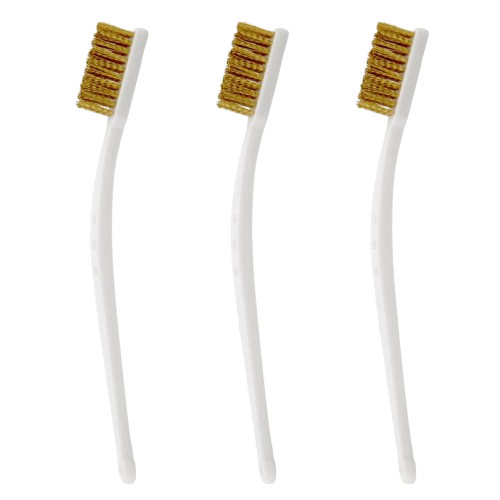
Wipes carbonized residue off the hot nozzle exterior without scratching the brass, so purged material stops sticking.
Amazon →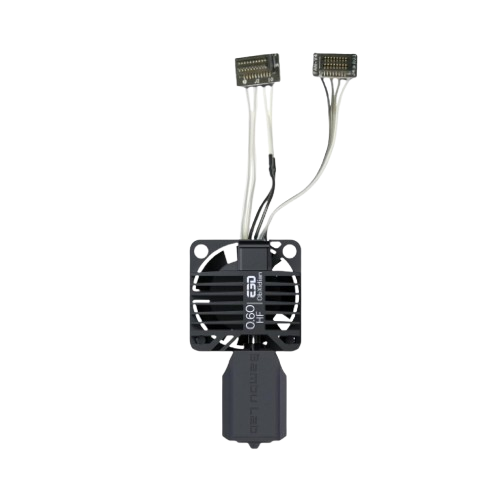
Hardened 0.6mm high-flow replacement nozzle for the P1P and P1S, for when cleaning fails and the tip is worn or permanently blocked.
Amazon →The A1 alternative: hardened steel 0.4mm nozzles for the A1 and A1 Mini quick-swap hotend, so a fresh spare is always ready.
Amazon →Affiliate links. We may earn a small commission at no extra cost to you.
Clog-related HMS codes
If Bambu Handy or Bambu Studio shows one of these HMS codes, it maps to the problem on this page. Each code links to Bambu's official step-by-step fix; come back here if the official steps don't solve it.
HMS_0700-2000-0002-0009– Failed to extrude, extruder may be clogged · official fixHMS_0700-7000-0002-0001– Failed to pull filament out, clogged extruder likely · official fixHMS_1200-2000-0002-0006– AMS lite (A series): failed to extrude, possible clog · official fixHMS_0300-0200-0001-0008– Nozzle cannot reach target temperature · official fix