X1 Carbon
DiscontinuedThe printer that put Bambu on the map. Lidar first-layer scanning, AI spaghetti detection, full enclosure: the X1C delivered the best quality Bambu could produce at the 300°C tier. Discontinued March 2026, its successor is the X2D ($649), which adds a dual nozzle and active chamber for far less money.
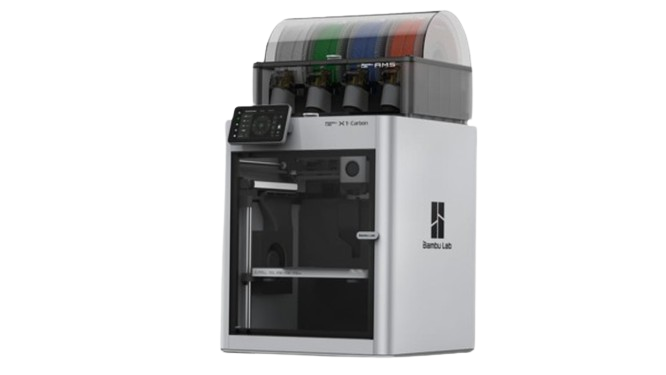
Bambu ended the X1 Carbon (and the whole X1 series) on 31 March 2026. It is no longer sold new. The successor is the X2D ($649), which adds a dual nozzle and active 65°C chamber for far less than the X1C cost.
Should I buy the X1 Carbon?
The X1 Carbon is discontinued. If you specifically want Lidar-based quality sensing, look for a used unit. For a new machine, the X2D ($649) is the direct successor and beats it on most specs; the P2S ($549) is sufficient for most printing, and the H2S ($1,199) gets you a larger volume and active chamber.
| Motion & Print | |
|---|---|
| Build volume | 256 × 256 × 256 mm |
| Max speed | 500 mm/s |
| Acceleration | 20,000 mm/s² |
| Motion system | CoreXY |
| Layer resolution | 0.05–0.35 mm |
| Extruder | Direct drive |
| Nozzle (stock) | 0.4mm |
| Temperature & Enclosure | |
|---|---|
| Nozzle max | 300°C |
| Bed max | 110°C |
| Enclosure | Yes, fully sealed |
| Chamber heating | Passive (~45°C typical) |
| Air filter | Activated carbon (no HEPA) |
| Carbon filter | Yes |
| Bed surface | Textured PEI (magnetic) |
| Lidar sensor | Yes (first layer & flow) |
| AI failure detection | Yes (spaghetti detection) |
| Auto leveling | Yes (Lidar-assisted) |
| Vibration comp. | Yes (accelerometer) |
| Flow calibration | Yes (Lidar) |
| Camera | Yes (included) |
| AMS | AMS compatible (up to 4 units, 16 colors) |
| Connectivity | Wi-Fi 2.4GHz, LAN |
| Machine dimensions | 389 × 389 × 458 mm |
| Weight | ~17.8 kg |
| Power supply | 100–240V AC, 1000W |
| Status | Discontinued (March 2026) |
The X1 Carbon launched Bambu's reputation and remained capable right up to its discontinuation in March 2026: the Lidar first-layer calibration and AI failure detection were features you didn't find elsewhere in the P-series. At its $1,199 list price it always sat awkwardly, though: the P2S at $549 produces comparable quality for most prints, and the H2S at $1,249 delivers better specs for $50 more (larger volume, faster speed, higher temp, active chamber).
Its differentiator was Lidar-based quality control: genuinely useful for complex multi-layer engineering parts or high-value multi-color models where catching failures early saves material and time. Now that it is discontinued, the X2D ($649) is the direct successor: it drops Lidar for a Vision Encoder but adds a dual nozzle, active 65°C chamber, and a second AI camera for $550 less. Buy a new X1C only if you find one at a genuine clearance price and specifically want its Lidar.
Pros
- Lidar first-layer calibration: best in class
- AI spaghetti/failure detection
- Fully sealed enclosure with activated carbon
- AMS up to 16 colors
- Camera and remote monitoring included
- Proven, long-standing platform with excellent support
- Best Bambu print quality at the 300°C tier
Cons
- Discontinued March 2026. No longer sold new
- Successor X2D ($649) beats it on most specs for less
- $1,199 list price was hard to justify vs P2S ($549) for most prints
- H2S ($1,199) has more specs for $50 more
- 300°C hotend cap: no PC or high-temp PA
- Passive chamber only, no active heating
- Same 256mm build volume as much cheaper printers
- AMS sold separately in standalone version
| Material | Support | Notes |
|---|---|---|
| PLA / PLA+ | Excellent | Lidar calibration makes already good PLA prints even better. |
| PETG | Excellent | Lidar catches any first-layer adhesion issues early. |
| ABS / ASA | Excellent | Sealed enclosure with passive heating handles these well. |
| TPU | Supported | Works. Flexible filament handled well by direct drive. |
| PA-GF / PA6 | Workable | Passive chamber marginal for some PA grades. Dry filament essential. |
| CF composites | Hardened nozzle | Use hardened nozzle. Lidar helps verify layer adhesion on CF prints. |
| PC | Not supported | 300°C hotend insufficient. |
| PA-CF (high-temp) | Not recommended | Passive chamber not enough. Use H2S for serious PA-CF work. |
Lidar calibration: Let the X1C run its full first-layer Lidar scan on every print. It adds 2–3 minutes but catches bed offset issues before you waste filament on a failed run.
ABS/ASA: Pre-heat the chamber for 15–20 minutes before starting. Set bed to 100°C and let the sealed enclosure warm up. The passive ~45°C chamber is effective once pre-heated.
LAN mode: Enable LAN Only + Developer Mode in Settings for Orca Slicer. Connect via local IP and access code.
X1C or P2S? P2S at $549 if you want the best value enclosed printer. X1C if Lidar quality sensing and AI failure detection are worth $650 more to you.
X1C or H2S? H2S is $50 more but gets you 1000 mm/s, 350°C, active 65°C chamber, and a larger build volume. Choose X1C only if you specifically need Lidar quality sensing.
Does Lidar really matter? For most prints: you won't notice. For long, complex prints with fine features: you will. It's insurance more than a daily benefit, but when it catches a failure at layer 1 instead of hour 6, it pays for itself.
AMS with the X1C? Yes, the full AMS (not AMS Lite). Up to 16 colors. AMS is included in some combo packs or sold separately.