X1C to X2D: Should You Upgrade?
Published · Full spec comparison →
Short version
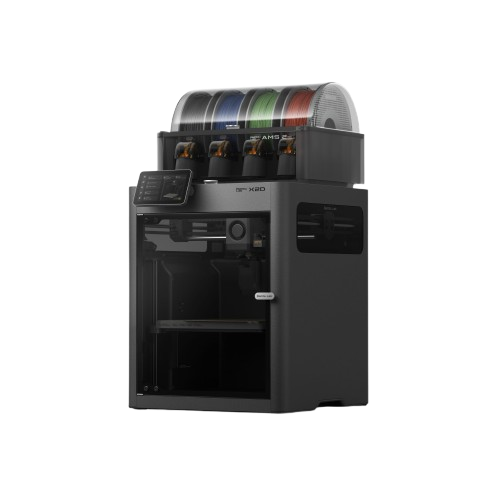
If you print multi-material or engineering plastics (ABS, ASA, Nylon) and want cleaner supports, the X2D is a real upgrade: it adds a second nozzle and an active 65°C chamber, and it costs less than the X1C did. If your X1C workflow depends on Lidar first-layer scanning and flow calibration, stay put. The X2D drops Lidar, and that is the one thing it does not replace.
Why this question exists now
The X1 series was discontinued on March 31, 2026, and the X2D launched two weeks later on April 14 at $649 as the official X1 Carbon successor. So every X1C owner faces the same choice: is it worth moving to the new machine, or does the X1C still hold up? Since the X1C already does its job well, this is a genuine decision, not an automatic upgrade. (For the discontinuation itself, see The X1 Series Is Discontinued.)
What the X2D adds over the X1C
1. A second nozzle
The X2D has two hot ends. The left nozzle is a direct-drive unit (up to 300°C, higher speed) for your main material. The right nozzle is a lighter Bowden unit meant for support material such as PVA or BVOH. A dedicated support nozzle means no purge tower for nozzle-switch waste and cleaner support interfaces. The X1C is single nozzle, so any support-material or multi-material work there runs through the AMS with the usual purge overhead.
2. An actively heated chamber
The X2D actively heats its enclosure to 65°C and holds that regardless of room temperature. The X1C has a passive enclosure that warms as a side effect of printing, landing around 45°C in practice and drifting with ambient conditions. The active chamber is what makes large ABS, ASA, and Nylon parts print reliably without warping or delamination. This is the single most practical difference for engineering work.
3. A lower price and newer AMS support
The X2D starts at $649 ($899 for the Combo with an AMS 2 Pro). The X1C's MSRP was $1,199. On top of that, the X2D supports the 25-color AMS 2 Pro, versus the original 16-color AMS the X1C shipped with. So the newer machine is both cheaper and more capable on color count.
What the X2D does not have: Lidar
This is the deciding factor for many X1C owners. The X1 Carbon carries a Lidar sensor that does real-time first-layer scanning and automatic flow calibration. The X2D replaces this with camera-based calibration. There is also no true IDEX: the X2D's second nozzle switches with a mechanical gear-and-trigger mechanism, and the right nozzle is capped at 200 mm/s, so it is a support nozzle rather than a full second toolhead.
An optional Vision Encoder add-on brings 50-micron motion accuracy to the X2D for users who need tighter precision, but it is not the same feature as Lidar and it is not included in the base price. If you actively rely on Lidar (unattended overnight production, tricky first-layer materials, precise flow calibration), the X2D is a sideways move on that axis, not an upgrade.
Who should upgrade
- Multi-material printers. If you regularly use dissolvable or breakaway supports, the dedicated support nozzle is a clean, waste-saving win the X1C can't match.
- ABS / ASA / Nylon printers. The active 65°C chamber turns finicky engineering-plastic prints into reliable ones, especially on larger parts.
- Color-heavy printers. Moving from 16 to 25 AMS colors (AMS 2 Pro) meaningfully expands multi-color work.
- Anyone buying a second printer. At $649 the X2D adds capability to a shop for less than the X1C cost, and it is on a currently supported platform.
Who should stay on the X1C
- Lidar-dependent workflows. If first-layer scanning and flow calibration are part of how you get reliable prints, the X1C keeps that and the X2D does not.
- PLA / PETG-only printers. If you never touch ABS or supports, the active chamber and second nozzle add little for you. Your X1C already covers the job.
- Owners with no pain point. The X1C is still supported: Bambu says spare parts will remain available for years, and firmware fixes are committed through May 2027. If nothing about your current setup frustrates you, there is no reason to spend money.
| Feature | X1C (own) | X2D (upgrade) |
|---|---|---|
| Price (MSRP) | $1,199 | $649 |
| Chamber heating | Passive ~45°C | Active 65°C |
| Nozzles | 1 | 2 (DD + Bowden support) |
| Max nozzle temp | 300°C | 300°C |
| AMS colors | 16 (AMS) | 25 (AMS 2 Pro) |
| Lidar / flow calibration | Yes | No (camera-based) |
| Build volume | 256 × 256 × 256mm | 256 × 256 × 260mm |
The bottom line
The X2D is a better all-round machine than the X1C for less money, with one asterisk: no Lidar. If you print engineering plastics, use supports, or want more AMS colors, upgrading is easy to justify. If Lidar is load-bearing in your workflow, or you only run PLA and PETG, keep the X1C, it is supported for years and still does the job. For the exact spec-by-spec breakdown, see the full comparison.