Bambu H2D Bed Adhesion: Why Corners Lift (When the X1C Prints Fine)
Published · H2D troubleshooting
Short version
If your Bambu H2D lifts a corner mid-print, especially with PLA, while the exact same file and slicer settings print perfectly on your X1C, you are not imagining it. The H2D's heated bed is less uniform than the X1C's: it has slightly cooler zones where adhesion is weaker. Bambu acknowledges some temperature variation but frames it as normal physics. In practice a proper heat-soak, a genuinely clean plate, a few degrees more bed temperature and a slower first layer fix it for most people. A minority with a truly faulty plate end up on a replacement case.
The symptom: same file, two different results
The pattern owners describe is consistent: corners or edges lift, often repeatedly at roughly the same spot on the plate, with PLA hit hardest and PETG needing a brim to stay down. The tell that it is not just your settings is the side-by-side: one H2D owner reports that "sending the same model and slicing parameters to my X1Cs results in a flawless print, zero adhesion issues," while the H2D lifts a corner on the same job. When the H2D prints do stick, the quality is excellent, which points at adhesion rather than calibration.
Which corner lifts varies from unit to unit, so there is no single "always front-left" spot to point at. It tracks with wherever that particular bed runs cooler.
What is actually going on: an uneven bed
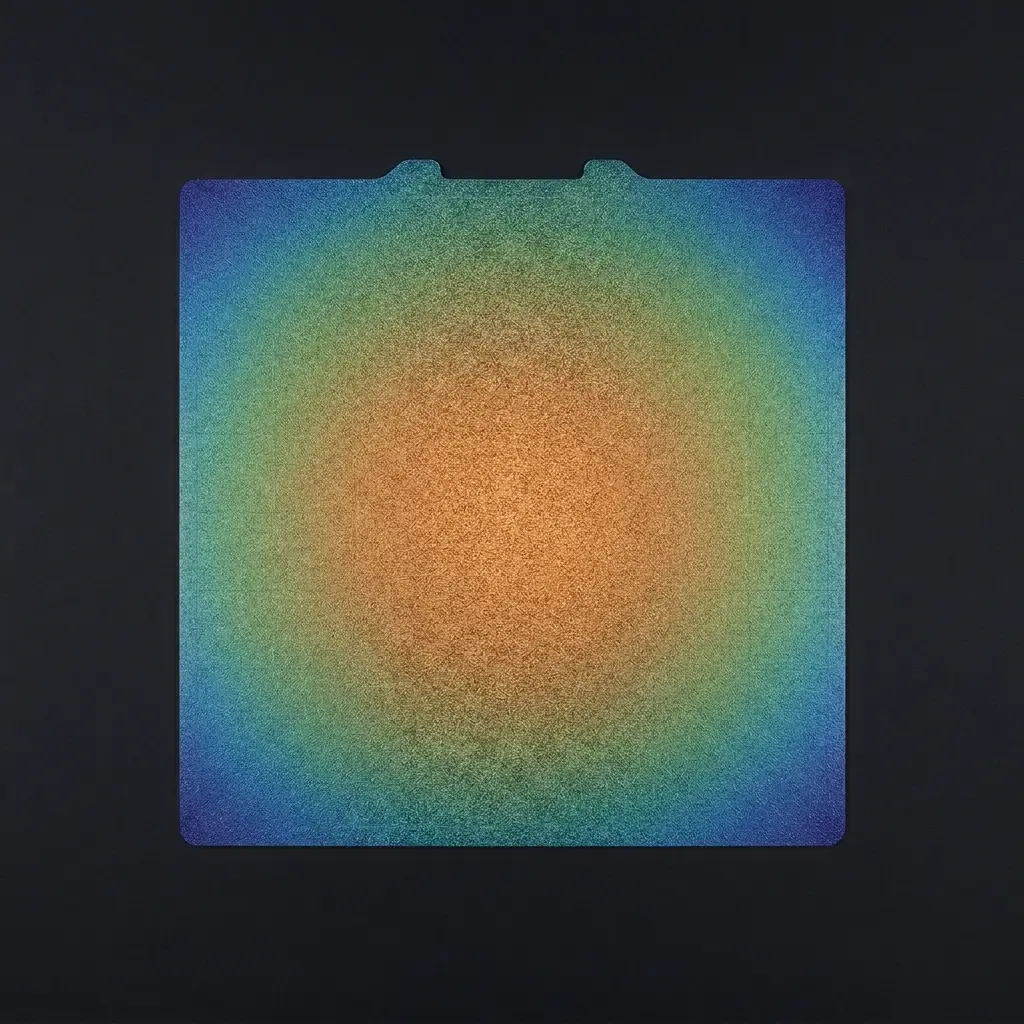
The H2D's heated bed does not warm perfectly evenly. It has cooler zones, and on those zones the first layer bonds less firmly, so the part can peel up as it cools and contracts. Two sets of numbers get quoted, and it is worth keeping them straight:
| Bed setting | Reported variation | Source |
|---|---|---|
| 65 °C | ~4 °C | Bambu support account, official forum |
| 100 °C | ~7 °C | Bambu support account, official forum |
| 100 °C bed + 65 °C chamber | ~5 °C | Bambu support account, official forum |
| Across the plate (thermal camera) | ~10 °C | CNC Kitchen, as reported on the forum |
Two honest caveats on those figures. Bambu's 4 to 7 °C numbers come from a support account answering on the official forum, measured with a thermocouple after five to six minutes of stabilization, not from a published datasheet. The ~10 °C figure is a forum user's paraphrase of what reviewer CNC Kitchen measured with a thermal camera, not a direct quote, so treat it as reported rather than exact. The gap between the two is itself informative: the higher number is likely measured before the bed is fully soaked, which is exactly why the first fix below is heat-soak.
How to fix it, in order
Work down this list. The early steps are cheap and fix the majority of cases; the later ones are for beds that still misbehave after the basics.
- Clean the plate properly. Wash it with dish soap and warm water, then wipe with 99% isopropyl alcohol, not 70% (70% leaves a mineral film). Afterwards handle it only by the edges. Finger oils are the single most common adhesion killer, independent of the bed, so rule this out first.
- Heat-soak the bed. Bring the bed to temperature and hold it for 5 to 15 minutes before you start. This is the step that targets the actual problem: the cooler zones shrink once the plate is warmed all the way through, and Bambu's own 4 to 7 °C figures only apply after that stabilization. Several owners report that a slow or manual heat-up before sending the print makes the difference between reliable and hit-or-miss.
- Raise the first-layer bed temperature by about 5 °C. More heat means more adhesion and helps offset the cooler zones. A standard, low-risk troubleshooting step.
- Slow the first layer to 20 to 30 mm/s. Or simply halve the two first-layer speed values in the slicer. More contact time lets the plastic weld to the plate and forgives a cool zone. Owners report this alone often removes the need for a brim.
- Ease off part cooling at the start. Lower the fan, or turn the auxiliary fan off, for the first layers. Full cooling on an already-marginal first layer makes lifting worse. Do not overdo this on PLA generally, but for the first layers it helps.
- Try a grippier plate if it lifts at the edge. Owners of the H2 series report aftermarket high-grip plates (for example the BIQU CryoGrip Pro) as a big improvement over standard PEI for this. Treat that as an owner recommendation: we have not independently tested those plates, so it is a lead to try, not a BambuHub endorsement.
- As a rescue, use a brim or a little glue. A 5 to 8 mm brim (10 to 15 mm for tall or thin parts), or a thin haze of glue stick on a cool plate, will save a print. Neither fixes the cause, but they get the job done while you tune the rest.
- Do not let auto-calibration overwrite your tuning. If you dialed in manual first-layer settings, turn off the auto calibrations at the print-confirmation screen so they do not override them.
Is it a defect? When to contact Bambu
For most owners this is not a warranty case. Heat-soak, a clean plate, a slightly hotter and slower first layer, and it comes under control. The H2D's first layer is genuinely fussier than the X1C's, but it is manageable.
It tips into a support or replacement case when all of the following are true: it lifts reproducibly at the same spot, on a verified clean and reasonably new plate, after you have worked through the steps above, and a bed photo or thermal image shows a clearly localized cold zone. That points at a faulty plate or bed heater rather than technique, and owners have received replacement plates on that basis. Document the uniformity before you open a ticket: a cheap thermal camera, or several identical calibration cubes spread across the whole plate, makes the case for you.
The realistic bottom line
The "set it and forget it" first layer that X1C owners are used to is not quite there yet on the H2D. Budget a one-time 15 to 20 minutes: build the heat-soak habit and set a slightly hotter, slower first layer, and it settles down. If you expect flawless full-bed first layers with zero tuning, you will be frustrated (a small minority never fully get there, but they are the exception). For most people it is a fussier bed, not a broken machine.
Sources: the H2D heated-bed temperature-uniformity thread on the official Bambu Lab forum (the 4 to 7 °C variation figures come from a Bambu support account there, and the ~10 °C figure is that thread's paraphrase of reviewer CNC Kitchen's thermal-camera measurement, not a direct quote); Bambu Lab's official H2D first-layer optimization wiki guide; owner reports on r/BambuLab and the Bambu forum; and ADP Industries' Bambu bed-adhesion guide for the prioritized cleaning, temperature, speed and brim steps. The temperature figures are presented as reported by their sources rather than as published specifications, and aftermarket plate names are owner recommendations we have not independently tested.