P2S
Best value enclosedThe P1S replacement Bambu didn't have to make better, but did. Same build volume, fully enclosed, now with 600 mm/s, a passive ~50°C chamber, at a $549 list price. The default answer to "I want a Bambu that prints ABS" alongside the discounted P1S ($399, the budget route).
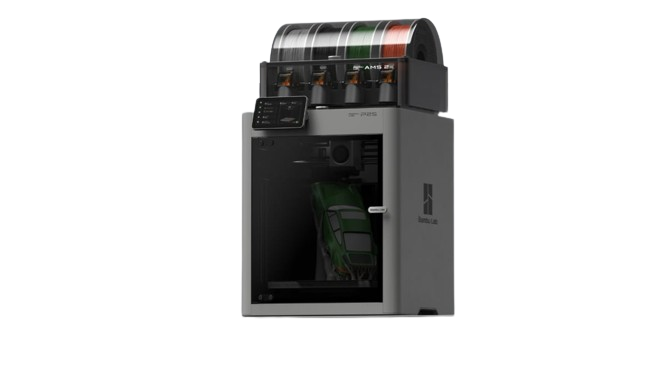
Should I buy the P2S?
Yes. It's the most straightforward buying decision in Bambu's lineup. If you want a fully enclosed machine that handles ABS and ASA reliably, costs under $600, and works out of the box, this is it. Better than the P1S at a lower price.
| Motion & Print | |
|---|---|
| Build volume | 256 × 256 × 256 mm |
| Max speed | 600 mm/s |
| Acceleration | 20,000 mm/s² |
| Motion system | CoreXY (updated) |
| Layer resolution | 0.05–0.35 mm |
| Extruder | Direct drive (updated) |
| Nozzle (stock) | 0.4mm |
| Temperature & Enclosure | |
|---|---|
| Nozzle max | 300°C |
| Bed max | 110°C |
| Enclosure | Yes, fully sealed |
| Chamber heating | Passive (~50°C typical) |
| Air filter | Activated carbon (no HEPA) |
| Carbon filter | Yes |
| Bed surface | Textured PEI (magnetic) |
| Auto leveling | Yes |
| Vibration comp. | Yes |
| Flow calibration | Yes (automatic) |
| Camera | Yes (included) |
| AMS | AMS 2.0 compatible (up to 16 colors) |
| Display | Touch LCD |
| Connectivity | Wi-Fi 2.4GHz, LAN |
| Machine dimensions | ~389 × 389 × 458 mm |
| Weight | ~17 kg |
| Power supply | 100–240V AC, 1000W |
| Status | Current (Oct 2025) |
The P2S is a better P1S at a lower price, which makes the P1S effectively irrelevant for new buyers. The 600 mm/s top speed is a genuine improvement, you'll print at 300–400 mm/s for good quality results, but the headroom is there. The passive chamber reaching ~50°C (vs ~40°C in the P1S) is a small but meaningful improvement for materials sensitive to temperature differentials.
AMS 2.0 compatibility is a real advantage: improved reliability and filament change speed over the original AMS. The 300°C hotend means PC and high-temp PA-CF are still off the menu, for those, you need the H2S. But for PLA, PETG, ABS, ASA, and CF composites, the P2S covers everything needed.
Pros
- Best price-to-capability in Bambu's enclosed lineup
- 600 mm/s, meaningfully faster than P1S
- Passive ~50°C chamber: reliable ABS/ASA
- activated carbon filtration included
- AMS 2.0 compatible for multi-color
- Camera included for remote monitoring
- 110°C bed: handles engineering materials
- Full auto-calibration suite
Cons
- 300°C hotend: no PC or high-temp PA
- Passive chamber only (vs active 65°C in H2S)
- Same 256mm volume as cheaper A1
- No Lidar (X1C feature only)
- AMS 2.0 sold separately (~$300+)
- Cloud-dependent by default (LAN+Dev mode workaround)
| Material | Support | Notes |
|---|---|---|
| PLA / PLA+ | Excellent | Native. Open the door for better cooling if needed. |
| PETG | Excellent | Very good. Use glue on PEI to prevent over-adhesion. |
| ABS | Excellent | The ~50°C passive chamber handles ABS reliably. Let it pre-heat. |
| ASA | Excellent | Even better than ABS in some cases. Great results. |
| TPU (85A–95A) | Supported | Works well with direct drive. |
| PLA-CF / PETG-CF | Hardened nozzle | Abrasive. Swap to hardened nozzle. |
| ABS-CF / ASA-CF | Hardened nozzle | Hardened nozzle + enclosure. Works well. |
| PA-GF / PA6 | Workable | Passive chamber marginal for demanding PA grades. Dry filament required. |
| PC | Not supported | Needs 350°C+. Use H2S. |
| PA-CF (high-temp) | Not recommended | Active heated chamber required. Use H2S. |
ABS/ASA pre-heat: Heat the bed to 100°C and let the sealed chamber warm up for 15 minutes before starting. The ~50°C passive chamber dramatically reduces corner lifting.
PLA cooling: For PLA, crack open the door slightly or lower chamber temperature settings. The enclosure can cause over-heating for low-temp materials.
AMS 2.0: Note that the original AMS (from P1S/X1C) is not compatible with the P2S connector system. If buying new, get AMS 2.0.
LAN mode: Enable LAN Only + Developer Mode in Settings for Orca Slicer.
P2S or P1S? The P2S is faster (600 mm/s) and better in every spec that differs. But the P1S costs $399, $150 less than the P2S: P1S = budget pick, P2S = performance pick.
P2S or A1? A1 ($299) if you only print PLA/PETG and want to spend less. P2S ($549) if you want ABS/ASA capability, an enclosure with carbon filtering, or 600 mm/s speed.
P2S or H2S? P2S if your materials stop at ABS/ASA. H2S ($1,199) if you need PC, PA-CF, or high-temp engineering materials with an active 65°C chamber.
Is AMS 2.0 compatible with old AMS? No. The P2S uses a new connector system. Only AMS 2.0 units work with the P2S.
Starter accessories for the P2S
What we would add to a new P2S in the first month.
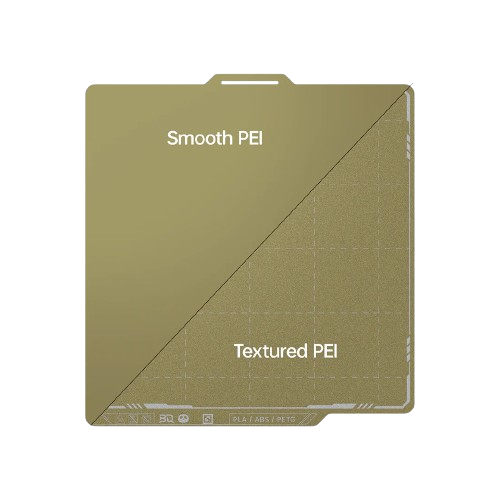
Textured 257 mm PEI plate that fits the P2S. Keep a spare so a cooling plate never blocks the print queue.
Amazon →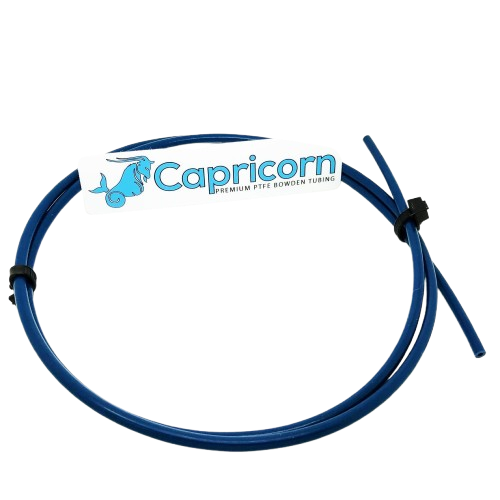
Tighter-bore PTFE for the P2S AMS path. Smoother feeding on long multi-color jobs.
Amazon →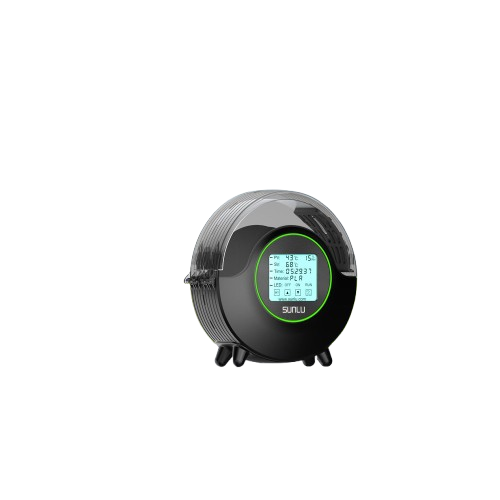
Dry spools make the biggest quality jump on PETG and nylon, both of which the P2S handles well.
Amazon →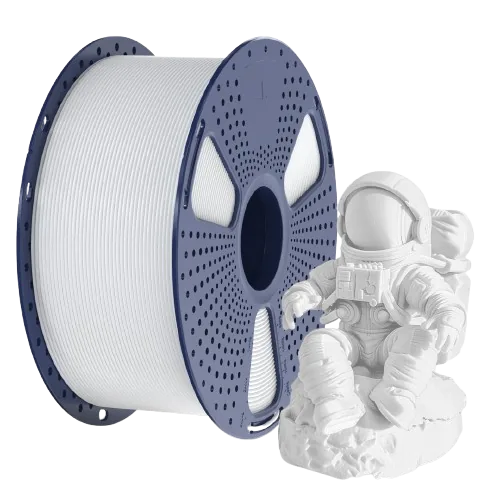
Cheap, consistent PETG for functional parts. Pairs well with the P2S enclosure and stock profiles.
Amazon →Affiliate links. We may earn a commission at no extra cost to you.