Bambu Lab A2L: The Largest A-Series Printer Yet
Published · Full spec page →
Short version
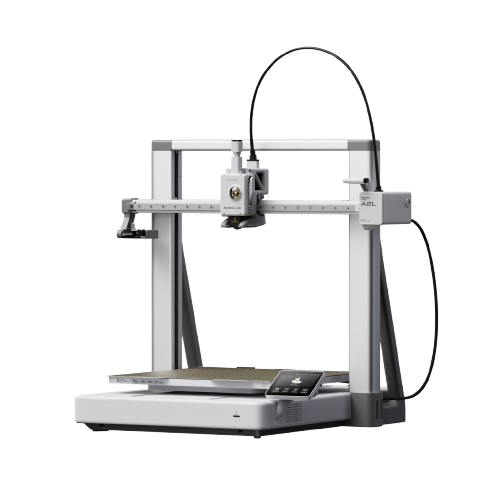
The A2L is a $469 open-frame printer with a 330 × 320 × 325 mm build volume, roughly 105% more space than the A1, making it the largest A-series machine yet. It keeps the beginner-friendly A-series formula: single direct-drive nozzle with a built-in filament cutter, AMS lite for multi-color (up to 19 colors chained), and adaptive vibration compensation. No enclosure and no heated chamber, so it is a PLA, PETG and TPU machine. The twist is an optional ~$60 cutting module that turns it into a Cricut-style plotter. If you want the most bed on a budget, this is it.
The basics
Bambu Lab launched the A2L on June 1, 2026. It starts at $469 for the standalone unit and $569 for the Combo, which bundles AMS lite. That places it $70 above the A1 ($399 at launch; the A1 now sells for $299) and $80 below the enclosed P2S ($549), squarely in budget territory.
The headline is size. The A2L has a 330 × 320 × 325 mm build volume, about 105% more usable space than the A1's 256 × 256 × 256 mm. That is the largest build volume in the entire A-series and one of the cheapest large beds you can buy inside the Bambu ecosystem. It keeps the open-frame bed-slinger design, prints up to 500 mm/s, and uses a textured PEI plate with automatic bed leveling and flow calibration.
Single nozzle with a filament cutter
The A2L uses a single 0.4 mm direct-drive nozzle rated to 300°C, with an integrated filament cutter built into the toolhead. The direct-drive setup handles flexible TPU well and keeps the extrusion path short. The filament cutter matters most for multi-color work: clean cuts between color changes make AMS lite swaps more reliable and reduce jams at the hotend.
Because it is a single nozzle, multi-color printing still works by purge-and-swap rather than a second hotend. That means color changes produce purge waste, and color-heavy models take longer and burn more filament. It is the standard A-series trade-off, unchanged here.
AMS lite: up to 19 colors
The A2L works with AMS lite, Bambu's open-spool automatic material system for the A-series. You can chain up to four AMS lite units for as many as 19 colors in a single print. That is a lot of color for a budget machine, though the single-nozzle purge cost scales with the number of changes, so plan a purge bin and expect longer prints on colorful models.
The optional cutting module
The standout feature is an optional Cutting Upgrade Kit, priced around $60. It swaps the print head for a drag knife and pen module, letting the A2L work like a Cricut: cut vinyl, stickers, cardstock and paper, or draw with the pen. It reuses the printer's own motion system, so a single open-frame machine becomes both a large-format 3D printer and a cutting plotter. Nothing else in Bambu's current lineup does this. We cover the cutting module in depth in a separate article.
Adaptive vibration compensation
The A2L includes adaptive vibration compensation. On a large bed-slinger this is more than a nice-to-have: the bigger the moving bed, the more resonance and ringing you get at speed. Adaptive compensation measures and corrects for those vibrations so surface quality holds up on large, fast prints, which is exactly the workload this printer is built for.
What it is not: no chamber, no Lidar
The A2L is an open-frame machine. There is no enclosure and no heated chamber; the bed tops out at 80°C. That makes it a PLA, PETG and TPU printer. ABS, ASA and Nylon warp and crack on an open frame, so if you need those, you want an enclosed, chamber-heated machine like the P2S or X2D instead. See our chamber guide for why this matters.
There is also no Lidar. The A2L relies on standard auto-leveling, automatic flow calibration, and a camera for timelapse. Lidar-grade first-layer and flow sensing is reserved for higher-end Bambu models.
A2L versus A1
The A2L is essentially a supersized A1. Here is what changed.
| Feature | A1 | A2L |
|---|---|---|
| Price (standalone) | $399 | $469 |
| Price (Combo) | $499 | $569 |
| Build volume | 256 × 256 × 256 mm | 330 × 320 × 325 mm |
| Nozzle | 1 Direct Drive | 1 Direct Drive + filament cutter |
| Bed max | 65°C | 80°C |
| Enclosure | No | No |
| AMS | AMS lite | AMS lite (up to 19 colors) |
| Cutting plotter kit | No | Optional (~$60) |
| Vibration comp. | Yes | Yes (Adaptive) |
For $70 more standalone, the extra build volume alone makes the A2L worth it if you print large. If 256 mm is enough, the A1 stays the cheaper pick.
A2L versus P2S
The A2L and P2S sit only $80 apart but target different jobs. The P2S ($549) is enclosed, so it adds ABS and ASA and keeps a more contained build. The A2L ($469) has a much larger open bed, the cutting-plotter option, and a lower price, but no enclosure. Choose the P2S if you need engineering-ish materials in an enclosure; choose the A2L if you print mostly PLA and PETG, want a big bed, and like the cutting twist. Our full A2L vs P2S comparison breaks it down.
Who it is for
The A2L is for the maker who wants maximum build volume without leaving budget territory. If your bottleneck has been bed size on a cheap printer, this is the cheapest way to solve it inside the Bambu lineup. It suits large PLA and PETG prints, multi-part plates, classrooms, and small craft businesses, especially ones that would use the cutting module. It is not for you if you need ABS, ASA or Nylon reliably, or if you want Lidar-grade first-layer sensing. For those, step up to an enclosed or higher-end machine.