Bambu Lab H3C: Nine Tools in One Printer, Specs and Price
Short version
Bambu Lab revealed the H3C on November 3, a tool-changer 3D printer with nine PrintTools that stay loaded and preheated in a rack. It costs $2,499 in Bambu's US store, sold only with the new nine-slot AMS 3H, builds up to 330 × 320 × 325 mm and can be ordered now; the store ships within 1 to 3 business days. Bambu puts a material switch at as little as 6 seconds, and one tool takes 2.85 mm filament for soft TPU. All specs are on our H3C spec page.
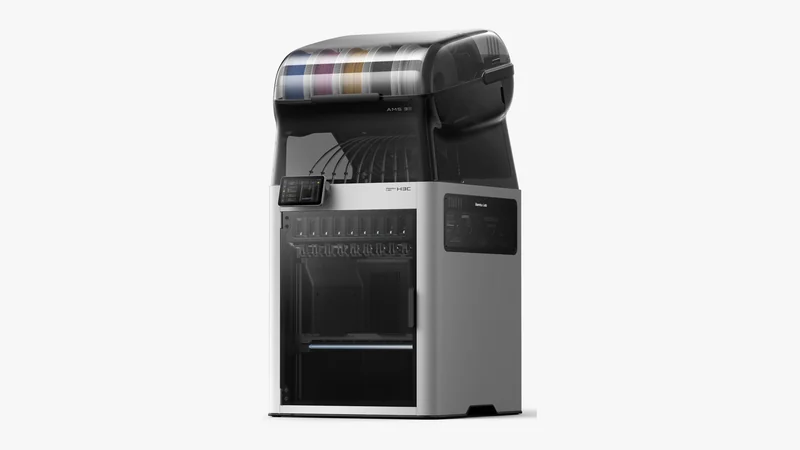
What Bambu announced on November 3
Bambu's product page keeps the teaser line “Tool Changer. Game Changer.” and opens its summary with “9-Material Printing, Low Purge Waste” and “6-Second Material Switching.” The specs as Bambu lists them:
| Spec | H3C |
|---|---|
| Price, Bambu US store | $2,499 |
| Configurations | H3C Combo with AMS 3H; with a filament starter pack $2,589; Full Combo with the Bambu Station L stand $2,799 |
| Build volume | 330 × 320 × 325 mm (13 × 12.6 × 12.8 in) |
| Tools | 9 PrintTools, each with its own heater, cutter and filament path |
| Materials per job | 9 from the AMS 3H, up to 24 spools with existing AMS units and the separately sold Buffer for External AMS |
| Max speed | 1,400 mm/s |
| Max acceleration | 25,000 mm/s² |
| Max nozzle temp | 350°C |
| Max bed temp | 120°C |
| Chamber | Active (65°C) |
| Filament | 1.75 mm; 2.85 mm for flexible filament on the included 2.85 mm PrintTool |
| Nozzles | Hardened steel, 0.2 to 0.8 mm; different sizes in one print |
| AMS | AMS 3H built in: 9 slots, 2 of them dried at up to 85°C |
| Weight | 36.28 kg including the AMS 3H |
| Network | Wi-Fi 6; no Ethernet |
| Orders and shipping | Orderable since November 3; the US store ships within 1 to 3 business days |
How the nine tools swap
Each PrintTool carries its own heater, cutter and filament path, so all nine materials stay loaded and nothing has to be pulled back before the next one starts. Bambu's Active Pre-Heat warms the next tool while the current one is still printing; Bambu gives 3.4 seconds per tool change and 6 seconds per material switch, with 0.038 g of purge per change. The extruder stays on the toolhead: Bambu's FlexFeed extruder switches between 1.75 mm and 2.85 mm filament with a cam-driven mechanism. Existing AMS units connect through PrintTool No. 1 for up to 24 spools; that takes Bambu's Buffer for External AMS, sold separately for $24.99 in its US store.
Price and availability
The H3C is sold only with the AMS 3H on top. Bambu's US store lists the H3C Combo at $2,499, with a filament starter pack (TPU plus CMYKW PLA) at $2,589 and as a Full Combo with the Bambu Station L stand at $2,799, with no launch discount. By the store's own note, orders ship from its US warehouse within 1 to 3 business days once processed. One of the nine tools ships as the 2.85 mm version, so nine colors in 1.75 mm need an extra 1.75 mm PrintTool, Bambu's FAQ says.
The first independent tests
CNC Kitchen published a review after almost 400 print hours on a unit from Bambu. It calls the 2.85 mm TPU support the standout feature and rates the print quality highly, with slight speed artifacts in the standard profiles. It measured about 50 mg on the prime tower per change, close to 200 g on a print with more than 4,000 changes, and 6 to 7 seconds per material switch. Its main complaints: a spool can only be changed after the printer unloads it, the AMS 3H dries only two slots, and with the AMS on top the machine is tall enough to want a low stand. On a smart plug it measured about 175 W printing PLA, 190 to 200 W for PETG and around 350 W for ABS and ASA with the heated chamber, with a brief spike to 1,600 W as heating starts, and about 20 W idle. Real print times ran about 5% over the slicer estimates.
mpoxDE tested a unit from Bambu for 414 hours. With a stopwatch it measured about 10 seconds per change including the prime tower. In a worst case against a Prusa Core One with INDX, an object 100 mm tall with 3,500 changes, the H3C finished more than three hours sooner, about 20% less print time, but its prime tower weighed 186.16 g against 29.74 g of Prusa purge waste. It measured about 220 W for an eight-color PLA print and up to 500 W for PA12 with drying and chamber heating. Two things for buyers: at a 120 °C setting the bed surface read 10 to 15 °C lower, a reading the tester calls uncertain with the AMS on top in the way, and H2C build plates are 5 mm longer in Y, so the H3C shows an error with one; he cut his down.
Tom's Hardware calls the H3C “an excellent nine-tool 3D printer” and lists the price and the height as its drawbacks. VoxelMatters got a soluble support filament stuck after skipping the drying the printer warned about, and cleared it by taking the hotend off its PrintTool, which takes three small screws.
Compared side by side: H2C vs H3C and H2D vs H3C.
What Bambu showed before the reveal
Bambu's H3C teaser page on bambulab.com carried the tagline “Tool Changer. Game Changer.” and the date “November 3, 9:00 AM EST”. The page described the H3C as “a next-generation tool changer 3D printer that makes multi-material printing faster, more reliable, and effortless.” On October 23 at 9:00 AM ET, Bambu's official account posted the teaser on r/BambuLab under the title “Nine tools in one printer.” with one more line: “A new tech to swap.”
The teaser video shows nine tools side by side in a rack, each with its own filament tube coming in from above. Until November 3, Bambu published no specs and no price for the printer itself. The name continues the H line after the H2D, H2S and H2C.
On October 26, Bambu showed the first product made for the H3C. A forum post from its official account introduces TPU 75A as “our softest yet” and shows a print made from TPU 75A and 90A in one build on the H3C. The EU store page lists it in 10 colors as 1 kg of filament with spool, matte and “certified for skin contact,” and marks it “Compatible only with H3C,” the first material Bambu lists for this printer alone.
- 2.85 mm, not 1.75 mm. The H2C takes 1.75 mm filament. The store names “FlexFeed” next to the diameter and lists a flow rate of 10 mm³/s, which Bambu puts at “~3× faster than conventional setups.” Since the reveal it is clear: FlexFeed is the H3C's extruder, and it takes both diameters.
- Price and AMS. TPU 75A costs $28.79 per 1 kg spool in Bambu's US store, on sale from its typical $47.99. The store lists it as not compatible with the AMS, AMS lite, AMS 2 Pro or AMS HT; on the H3C it feeds through the bypass.
- Dry it first. The cautions on the page read “Must dry out before use.”
Three more teasers followed on Bambu's forum, all from its official account shortly after 13:00 UTC. On October 28, “[Bambu Lab H3C] Introducing...Your print” says: “Seeing your creations built layer by layer is part of the fun. We would never take that away from you.” Its animation carries the line “Lift the veil, Enjoy the full show.” On October 29, “[Bambu Lab H3C] 0.2 or 0.4? Why not both” adds: “Speed where you want it. Detail where it matters.” Its image shows a watch with the words “ONE PRINT” and “Wrist Ready” and three labels: “Crisp Details” (0.2 mm, 1.75 mm), “Soft Strap” (0.4 mm, 2.85 mm) and “Rigid Case” (0.4 mm, 1.75 mm). On November 3 Bambu explained them: the watch is its example for mixed nozzle sizes in one print, a 0.2 mm nozzle for the dial, 0.4 mm for the case and a 0.4 mm nozzle for 2.85 mm TPU for the strap. On October 30, “[Bambu Lab H3C] HRC 55+. All of them” adds two lines: “Durable by design. Hardened by default.” Its FAQ now says every H3C nozzle from 0.2 to 0.8 mm is hardened steel, HRC 55+, and the spec page lists the extruder gear as hardened steel too. All three posts repeat the reveal time, “Nov 3, 9AM EST.”
When Bambu revealed it
Bambu revealed the H3C at 9:00 AM EST on Tuesday, November 3, 2026: 6:00 AM in Los Angeles, 14:00 UTC, 3:00 PM in Berlin. Orders were open in the US store when we checked at 16:33 UTC the same day.
What the FCC and Japanese filings add
The H3C has been on file since September. The FCC certified it on September 11 under FCC ID 2A6J8-PF008P, for Shenzhen Tuozhu Technology, the manufacturer named on Bambu's product labels. The test reports list 2.4 and 5 GHz Wi-Fi including 802.11ax, sold as Wi-Fi 6, and the label carries an 8 A rating, like the H2C's. At the FCC, the manual and photos stay confidential until March 10, 2027 at the latest, so the specs came from Bambu first, on November 3.
Japan's radio regulator already shows the printer. The Giteki certification for model PF008-P (number 211-260728, certified September 30) comes with external photos of a cube-shaped white enclosure with “Bambu Lab H3C” on the front, a touchscreen and a door; with the door open, a row of nine docks runs across the top of the build space, with nine receptacles below them and a single print head carriage on the gantry. That fits Bambu's count of nine tools, but the photos do not show whether each tool carries its own extruder.
The same batch of filings named a P3C printer (Japan's Giteki photos show it in gray with seven docks), an X2D Pro and two material units, AMS 3H and AMS 3P. The AMS 3H arrived with the H3C on November 3; the P3C, the X2D Pro and the AMS 3P are still unannounced. The full list is in our FCC filings article.
H3C next to the H2C
The H2C was Bambu's multi-material flagship until now and is the obvious comparison. Here is how the two compare now:
| Spec | H2C | H3C |
|---|---|---|
| What swaps | Hotends, from the Vortek rack | PrintTools: hotend with its own heater, cutter and filament path |
| Positions | 6 swappable hotends plus 1 fixed, up to 7 melt zones per job; up to 25 colors with AMS units | 9 PrintTools; 9 materials from the AMS 3H, up to 24 spools with extra AMS units |
| Build volume | 305 × 320 × 325 mm (right nozzle) | 330 × 320 × 325 mm |
| Max speed | 1,000 mm/s | 1,400 mm/s |
| Price, Bambu US store | $1,899 AMS Combo | $2,499 with AMS 3H |
| Filament | 1.75 mm | 1.75 mm, plus 2.85 mm on one tool |
| FCC label rating | 8 A | 8 A |
| Status | Announced November 2025, shipping | Revealed and on sale November 3, 2026 |
At current US store prices the H3C costs $600 more than the H2C AMS Combo; both prices include an AMS.
Tool changer or hotend changer?
The H2C already swaps parts, but only hotends: its Vortek rack parks six induction-heated hotends next to one fixed hotend, and the extruder stays on the toolhead.
In September we looked at a Bambu patent, CN 122560413 A, that shows a rack of nine hotends. In its drawings the extruder stays on the moving toolhead and only the hotend is parked, so we called it a hotend changer, not a toolchanger: the H2C's principle with more bays. Bambu now sells the H3C as a “tool changer” with nine tools. The count matches the patent, but Bambu has not tied the two together, and the teaser did not show whether each tool carries its own extruder.
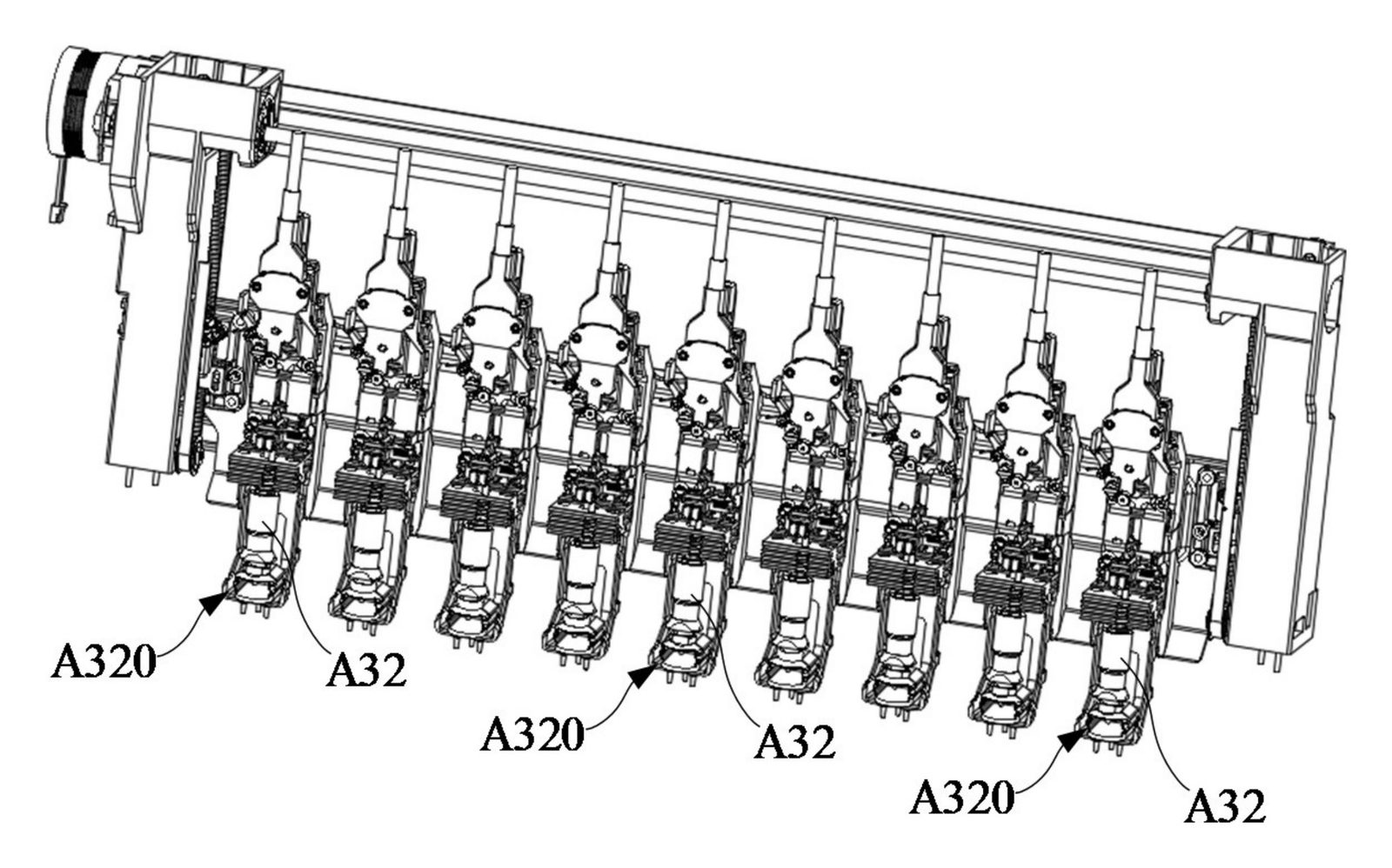
The difference matters. A true toolchanger parks the whole toolhead, so a switch is a docking move, and every tool needs its own extruder and motor. A hotend changer keeps one extruder and re-threads filament into a different melt zone on every swap, which is simpler and cheaper to build. Bambu's line “a new tech to swap” left both open until November 3.
Bambu's answer on November 3 sits in between. Each PrintTool carries its own heater, cutter and filament path, but the FlexFeed extruder stays on the toolhead and grips whichever tool is docked; CNC Kitchen's teardown shows the extruder gears reaching the filament through a cutout in each tool. So the H3C parks hotends, as our patent reading expected, but every hotend keeps its own loaded filament path, which is why a material switch takes seconds rather than a reload from the AMS.
What the H3C trades off
Bambu's own FAQ and wiki spell out where the nine-tool design sets limits:
- More than nine spools. Extra AMS units connect only to PrintTool No. 1 and need the Buffer for External AMS, which is not in the box; spools beyond the nine tools share that path and purge when they change.
- Drying. The AMS 3H dries two slots, and they share one drying chamber: Bambu's PVA guide sets the drying temperature to 55°C when PLA is in there for the same print, because PLA softens above that.
- Nozzle pairing. Each spool prints through its own tool's nozzle. For pairing any filament with any nozzle size automatically, Bambu itself points to the H2C.
Details and sources: H3C trade-offs on our spec page.
What is still unknown
- When Bambu publishes the first H3C firmware release notes; its wiki page says coming soon.
- Prices and shipping outside the US; we checked only Bambu's US store.
- Long-term wear of the tool docks and PrintTools over thousands of swaps.
- Which 2.85 mm materials follow TPU 75A; Bambu's FAQ only says more flexible ones are on the way.
- Whether Bambu offers an upgrade path from the H2C; it has not announced one.
Note
Purge and switch figures here are Bambu's own, except where we name the tests by CNC Kitchen and mpoxDE.
Should you buy or wait?
- Shopping for an H2C. The H3C costs $600 more than the H2C AMS Combo at $1,899; both include an AMS. For up to seven materials on a budget the H2C still does the job. For many materials per job or soft TPU, the H3C is the one to buy.
- Already own an H2C. Bambu has not announced an upgrade path. It does bring mixed nozzle sizes in one print to the H2C, expected in February 2027, or March 2027 with the Filament Track Switch.
- Two materials per part. The H2D covers soluble supports and two-material parts at $1,399 and gets mixed nozzle sizes in November 2026, by Bambu's estimate. More in H2D vs H3C.
- Printing one material at a time. Bambu pitches the H3C at multi-material printing, so nothing here changes your shortlist.
Sources
28 sources, including Bambu Lab product pages and store, Bambu Lab wiki, Bambu Lab forum, FCC filings, CNC Kitchen, Tom's Hardware and 4 more. Last checked November 4, 2026.
ShowHide
- Bambu Lab, H3C product page: SwapTek, Active Pre-Heat, FlexFeed, AMS 3H (read November 3, 2026)
- Bambu Lab H3C specs (read November 3, 2026)
- Bambu Lab H3C FAQ: PrintTools, nozzles, dimensions, AMS 3H dryer (read November 3, 2026)
- Bambu Lab US store, H3C: prices, configurations and shipping, checked November 3, 2026; FAQ on external AMS and the H2C (read November 4, 2026)
- Bambu Lab US store, Buffer for External AMS - H3C: price, not included as standard, checked November 4, 2026
- Bambu Lab Wiki, H3C FAQ: external AMS on PrintTool 1, the buffer, drying slots (read November 4, 2026)
- Bambu Lab Wiki, connecting multiple AMS units to the H3C (read November 4, 2026)
- Bambu Lab Wiki, H3C PVA printing guide: drying temperature when filaments share the drying chamber (read November 4, 2026)
- Bambu Lab blog, “H2D, H2C and X2D will support hybrid printing with multi-orifice nozzles” (November 3, 2026)
- Tom's Hardware, “Bambu Lab H3C 3D printer review” (November 3, 2026; verdict and drawbacks, read the same day)
- VoxelMatters, “VoxelMatters Reviews: Bambu Lab H3C, this is the way” (November 3, 2026, read the same day)
- CNC Kitchen, “Bambu Lab Finally Built the Toolchanger We Wanted!” (video review, published November 3, 2026; read via its captions the same day)
- mpoxDE, “Bambu Lab H3C: 414 Stunden im Test” (video review in German, published November 3, 2026; read via its English caption track the same day)
- Bambu Lab US store, TPU 75A (2.85mm): price and compatibility (read November 3, 2026; on October 31: “Available on November 3 at 13:45 PM (UTC)”, no price shown)
- Bambu Lab, H3C teaser page “Tool Changer. Game Changer.” (read October 23, 2026)
- Bambu Lab on r/BambuLab, “[Bambu Lab H3C] Nine tools in one printer.” (posted October 23, 2026, 13:00 UTC)
- Bambu Lab forum, “[Bambu Lab H3C] TPU 75A: Our softest yet” (posted October 26, 2026, 13:00 UTC)
- Bambu Lab forum, “[Bambu Lab H3C] Introducing...Your print” (posted October 28, 2026, 13:00 UTC; text and animation read October 29, 2026)
- Bambu Lab forum, “[Bambu Lab H3C] 0.2 or 0.4? Why not both” (posted October 29, 2026, 13:00 UTC; text and image read October 29, 2026)
- Bambu Lab forum, “[Bambu Lab H3C] HRC 55+. All of them” (posted October 30, 2026, 13:03 UTC; text read October 30, 2026)
- Bambu Lab EU store, TPU 75A (2.85mm): features, cautions, colors and the November 3 availability date (read October 26, 2026)
- Bambu Lab H2C specs, filament diameter 1.75 mm (read October 26, 2026)
- FCC ID 2A6J8-PF008P (H3C, granted September 11, 2026), read in our FCC filings article (October 7, 2026)
- Japan MIC Giteki record 211-260728, model PF008-P (H3C, certified September 30, 2026; external photos from test report 2604V72271E-RF, PDF served by MIC; read October 26, 2026)
- Japan MIC Giteki record 211-260730, model PF006-P (P3C, certified October 8, 2026; external photos; read October 26, 2026)
- Patent CN 122560413 A (CNIPA, August 14, 2026), read in our patent analysis (September 2, 2026)
- H2C Vortek and price: our H2C spec page and the Bambu US store (prices checked November 3, 2026)
- Time zones converted with the IANA time zone database
- Title
- Bambu Lab H3C: Specs, Price, Nine-Tool Changer
- Section
- News
- Published
- Last updated
- Prices checked
- November 3, 2026
- Type
- News
- Basis
- Bambu's announcement, spec page and store
- Sources
- Listed under the article
- Page
- Status
- Not affiliated with Bambu Lab