Bambu in the FCC Files: H3C, P3C, X2D Pro, AMS 3 and an S1 3D Scanner
Short version
Between September 11 and 22, 2026, the FCC certified seven devices for Shenzhen Tuozhu Technology, the manufacturer named on Bambu Lab's product labels. Three of them have not been announced: a printer labeled P3C, an X2D Pro and a material unit called AMS 3P. Three were unannounced at filing and have been confirmed since: the Bambu Lab S1, whose label reads “3D Scanner”, on October 12 for November 2026, and the H3C with its AMS 3H, announced on October 23 as a tool changer with nine tools and revealed and put on sale on November 3. The seventh is the R1 laser, which Bambu launched the day after its grant. The public files confirm names, product types, radios and the power ratings printed on the labels. One radio detail is new: the H3C and P3C test reports include 802.11ax, the standard sold as Wi-Fi 6, while the X2D Pro's reports list 802.11a/b/g/n only. The files contain no printer specs such as build volume or speed, and no prices or release dates. At the FCC, manuals and photos stay sealed until March 10 to 21, 2027, and that is a confidentiality limit, not a launch date: the X2D's photos only became public on October 7, 2026, almost six months after Bambu announced it. Japan's radio certification register already shows photos of the H3C and the P3C: a row of nine docks inside the H3C and seven inside the P3C; for the P3C there are still no specs, prices or dates.
- Title
- Bambu FCC Filings: H3C, P3C, X2D Pro, S1 Scanner
- Section
- News
- Published
- Last updated
- Type
- News
- Basis
- Read from the FCC and Japanese certification records, not from leaks
- Sources
- Listed under the article
- Page
- Status
- Not affiliated with Bambu Lab
Updates: Bambu confirms the H3C and the S1
October 23, 2026: Bambu has announced the H3C as a tool changer with “nine tools, built into one printer”. The reveal is on November 3 at 9:00 AM EST; specs, price and shipping are still open (Bambu H3C page, our H3C article).
October 12, 2026: Bambu has announced the S1 as “our first 3D scanner”, with a launch page tagged “Easy in Hand. Pro in Every Scan.” and the date “November 2026, Coming soon”. The page promises “pro-level scanning precision” but gives no accuracy figure, scanning method or price, so the questions below about what the S1 scans and how well are still open. The P3C, X2D Pro, AMS 3H and 3P are still unannounced (Bambu S1 page, Bambu forum announcement).
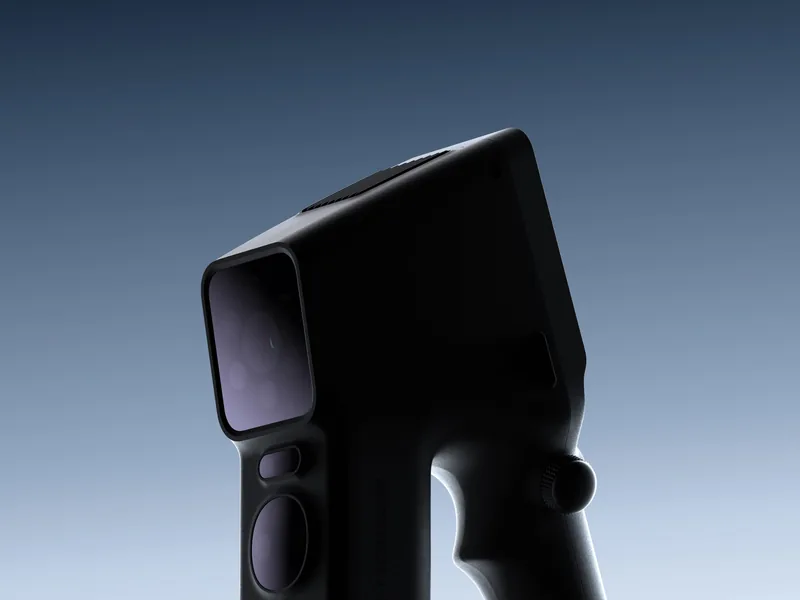
First photos: Japan's certification shows the H3C and P3C
Japan's radio certification register has published external photos of both unannounced printers, while the FCC keeps its photos sealed until March 2027. They show the white H3C with nine docks across the top of the build space and the gray P3C with seven (H3C external photos, P3C external photos). What they show and what they leave open is in What Japan's certification photos show.
- new FCC IDs under Bambu's grantee code, September 11 to 22, 2026
- 7
- of them not announced by Bambu (checked October 7, 2026)
- 6
- days of confidentiality Bambu requested for manuals and photos
- 180
The seven filings
Every FCC ID starts with a grantee codeThe first part of every FCC ID, assigned to one company. 2A6J8 is registered to Shenzhen Tuozhu Technology Co., Ltd., the company that also files Bambu's X2D, P2S, H2 and A-series printers.; Bambu's is 2A6J8. These are the entries added in September, with the product type exactly as each label prints it.
| Device (label) | FCC ID | Grant | Radio | What it points to (our reading) |
|---|---|---|---|---|
| X2D Pro “3D Printer” | 2A6J8-PF004E | Sep 11, 2026 | Wi-Fi 2.4 + 5 GHz 802.11a/b/g/n | An X2D variant: same PF004 model stem and same 7 A label rating as the X2D |
| H3C “3D Printer” | 2A6J8-PF008P | Sep 11, 2026 | Wi-Fi 2.4 + 5 GHz incl. 802.11ax | A new H-series machine with its own PF008 stem; 8 A rating, like the H2C |
| P3C “3D Printer” | 2A6J8-PF006P | Sep 15, 2026 | Wi-Fi 2.4 + 5 GHz incl. 802.11ax | A new P-series machine with its own PF006 stem; 8 A rating against the P2S's 5 A |
| R1 “Laser Cutter” | 2A6J8-LM001P | Sep 21, 2026 | Wi-Fi 2.4 + 5 GHz | Nothing new: the CO2 laser Bambu launched on September 22 |
| AMS 3H “Automatic Material System 3H” | 2A6J8-SA017 | Sep 21, 2026 | 13.56 MHz only | The RFID spool reader every AMS has; mains power input, like the AMS HT |
| AMS 3P “Automatic Material System 3P” | 2A6J8-SA018 | Sep 21, 2026 | 13.56 MHz only | The RFID spool reader; 24 V DC input only |
| Bambu Lab S1 “3D Scanner” | 2A6J8-DS001 | Sep 22, 2026 | Wi-Fi 5 GHz only | A battery-powered scanner, tested for exposure at the hands and limbs; a category Bambu has not filed before |
What the filings show
Everything in this section comes from the public part of each file: the grant, the test reports, the label drawings and the cover letters. We read the exhibit lists on the FCC's own database and the documents themselves on fccid.io, which mirrors the FCC record with readable copies.
| Device | Rated input on the label | Closest label Bambu already sells |
|---|---|---|
| X2D Pro | 100–120 V, 7 A | X2D (PF004P): 7 A |
| H3C | 100–120 V, 8 A | H2C (PF003C): 8 A |
| P3C | 100–120 V, 8 A | H2C: 8 A; P2S (PF004U): 5 A |
| AMS 3H | 100–120 V AC, 200 W, or 24 V DC, 1 A | AMS HT, mains: 100–240 V, 1 A |
| AMS 3P | 24 V DC, 1 A | AMS 2 Pro: 24 V DC, 4 A |
| Bambu Lab S1 | 20 V DC, 3 A, 60 W | No earlier Bambu scanner; battery 3.6 V, 4,800 mAh per the SAR report |
| R1 | 100–240 V, 5 A | Already launched, September 22, 2026 |
- Rated input: as printed on the label drawings in each FCC file, read October 7, 2026. A current rating alone does not say what a machine does with it.
Three printers: X2D Pro, H3C and P3C
All three labels read “3D Printer” and carry the Bambu Lab logo with the model name. Their frequency bands are identical: Wi-Fi at 2.4 GHz plus all four 5 GHz ranges (5.18 to 5.24, 5.26 to 5.32, 5.50 to 5.72 and 5.745 to 5.825 GHz). That is the same set the X2D's own filing covers. Bay Area Compliance Laboratories in Shenzhen tested all three, as it did the R1 and both AMS units.
The Wi-Fi modes are not identical. The H3C's test reports list 802.11ax (ax20 and ax40) at 2.4 and at 5 GHz, and the P3C's 5 GHz report lists the same; 802.11ax is the standard the Wi-Fi Alliance markets as Wi-Fi 6. The X2D Pro's reports list 802.11b/g/n at 2.4 GHz and 802.11a/n at 5 GHz, with no ax mode. These are the modes declared and tested for certification. They tell you which Wi-Fi standard the radio speaks, not what kind of machine is built around it.
The rated input printed on the labels is where they differ. The X2D Pro reads 100 to 120 V, 7 A, the same figure as the label of the X2D. The H3C and the P3C both read 100 to 120 V, 8 A, the figure on the H2C's label; the P2S label reads 5 A. On its own, a current rating does not tell you what a machine does with it.
The model numbers follow a pattern. The X2D Pro is PF004E, next to the X2D's PF004P and the P2S's PF004U. The P3C (PF006P) and the H3C (PF008P) got new numbers, while all four H2 machines filed so far share PF003 (H2D, H2S, H2C and H2D Pro). The H3C and P3C files each also contain a declaration that the printer can be built with one of three interchangeable 24 V power supply modules from different suppliers: 250 W modules for the H3C, 150 W for the P3C. The X2D Pro's file has no such declaration, but its test reports note two power supply modules, MOSO T40-TA042J240-250E0 and trelin DZTZ-250-24P. Both model numbers also appear in the H3C's declaration, rated 24 V, 250 W. The files do not say what those supplies power.
AMS 3H and AMS 3P
The labels spell the names out: “Automatic Material System 3H” (SA017) and “Automatic Material System 3P” (SA018). Each lists exactly one radio, a transmitter at 13.56 MHz, and no Wi-Fi or Bluetooth. That matches every AMS Bambu has filed before: the original AMS (2022), the AMS lite (2023), the AMS 2 Pro and the AMS HT (both 2025) are each listed at 13.56 MHz and nothing else.
The power inputs differ. The AMS 3H label reads 100 to 120 V AC, 200 W, or 24 V DC at 1 A. The AMS 3P label reads 24 V DC at 1 A only. For comparison, the AMS HT's label lists a mains input of 100 to 240 V, 1 A, and the AMS 2 Pro's label 24 V DC at 4 A.
Bambu Lab S1: a 3D scanner
The S1 (DS001) is the only new filing that is not a printer, an AMS or a laser, and its label is explicit: “3D Scanner / Escáner 3D”, input 20 V DC, 3 A, 60 W. Its SARSpecific absorption rate: how much radio energy the body absorbs, in watts per kilogram. The FCC sets different limits for the head and body and for the extremities. test report, written by SGS in Suzhou, classes it as a portable device, lists a 3.6 V, 4,800 mAh battery and describes the tested sample as a production unit.
Its radio setup is unusual for Bambu: Wi-Fi only, in two 5 GHz ranges (5.18 to 5.24 and 5.745 to 5.825 GHz). A signed declaration in the file says that the Bluetooth and 2.4 GHz Wi-Fi built into the device are disabled by software. The grant reports the highest SAR for “extremity exposure” at 3.81 W/kg; the FCC limit for hands, wrists, feet, ankles and outer ears is 4 W/kg. The printer and R1 grants work the other way round: they require at least 20 cm between the antennas and any person. The S1 was assessed for use against the hands or limbs.
R1: already launched
LM001P is the R1. The label reads “Laser Cutter” and “Class 1 Laser Product”, input 100 to 240 V, 5 A. The grant is dated September 21, 2026, and Bambu launched the R1 on its blog the next day; our R1 article has the specs and prices. It is the one entry in this batch that is not news.
What the filings do not show
No build volume, speed, nozzle count, chamber temperature, scan accuracy, price or date appears anywhere in the public part. Those details sit in documents Bambu asked the FCC to withhold: the user manuals, internal and external photos and test setup photos for 180 days, and the block diagrams, schematics and operational descriptions permanently. Still open:
- What the C in H3C and P3C stands for. The H2C is the model with Vortek, Bambu's induction hotend system (our H2C explainer); Bambu has not said what the letter stands for. Nothing in these files mentions hotends.
- What the X2D Pro adds. Ethernet, the obvious candidate for a Pro model, would not appear in an FCC radio filing at all.
- Whether the AMS 3H or 3P dries filament, and which printers they connect to. The labels show power inputs, not heaters.
- What the S1 scans, how accurately and with which software.
- Prices and release dates for any of the six.
Bambu itself has not mentioned any of them. Its blog, where it posted the launches of the H2D, H2D Pro, H2S, P2S, H2C, X2D, A2L and R1, has nothing on these six devices (checked October 7, 2026).
What Japan's certification photos show
The FCC keeps the photos sealed; Japan does not. Its radio certification database, run by the Ministry of Internal Affairs and Communications (MIC) and known as Giteki, lists the H3C and the P3C under Shenzhen Tuozhu Technology, certified by Bay Area Compliance Laboratories, the lab that also tested them for the FCC. Each entry holds an external photo report, an internal photo report and test reports, all public when we checked on October 26, 2026.
| Device | Japanese model | Giteki number | Certified | Docks on the photos |
|---|---|---|---|---|
| H3C | PF008-P | 211-260728 | Sep 30, 2026 | 9 |
| P3C | PF006-P | 211-260730 | Oct 8, 2026 | 7 |
The H3C's external photos show a cube-shaped white enclosure with “Bambu Lab H3C” at the top right of the front, a touchscreen at the top left and a front door. With the door open, a row of nine docks with orange tops runs along the top of the build chamber, with nine holders below them and the print bed underneath. Seen from above, the cross axis carries a single print head carriage. The P3C's photos show the same layout in a gray enclosure with “Bambu Lab P3C” on the front, a touchscreen at the top left, a door and seven docks with seven holders below. We counted the docks ourselves; the reports do not label them. Nine matches the “nine tools” Bambu announced for the H3C on October 23.
The photos do not show build volume, speed, temperatures, prices or dates, and nothing says what the docks hold. The internal photos show circuit boards, power supplies, antennas, wiring and housing parts. Bambu has still not announced the P3C; the H3C's specs have been public since its reveal on November 3 (our H3C page). We link to the documents under Sources instead of reproducing the photos here.
How to read an FCC filing
The confidentiality date is a limit, not a launch date
Bambu's cover letters ask for “short-term” confidentiality of the manuals and photos with a “secrecy cycle” of 180 days. That is why the release dates in the files land exactly 180 days after each grant: March 10, 2027 for the X2D Pro and the H3C, March 14 for the P3C, March 20 for the R1 and both AMS units, March 21 for the S1. The S1's letter adds that if the device is marketed within those 180 days, Bambu will notify the certification body, so the documents can also come out earlier.
Caution
The X2D shows the difference
The FCC granted the X2D on April 12, 2026, and Bambu announced it on April 14. Its manual and photos stayed sealed until October 7, 2026, almost six months later. A March 2027 date in a filing tells you when the documents become public at the latest, not when a product ships.
“Composite device” means two radios, not a hidden feature
The X2D Pro, H3C, P3C and R1 files are flagged as a composite deviceFCC term for equipment that needs more than one equipment classification under the same FCC ID, with a separate application for each.. Here that simply means dual-band Wi-Fi: each file holds two grants, one for 2.4 GHz under Part 15C and one for 5 GHz under Part 15E. The X2D, P2S, H2D, H2C and H2D Pro filings carry the same flag. The S1 (5 GHz only) and the AMS units (13.56 MHz only) need a single classification and are not composite.
13.56 MHz points to the spool reader
Bambu's wiki describes how the AMS reads the RFID tags on Bambu spools with dedicated reader boards (see AMS detection issues for what goes wrong with them). The 13.56 MHz entry fits that reader, and it is the only radio listed in every AMS filing, old or new. Most likely it covers the same tag reading on the AMS 3H and 3P; beyond that, it says nothing about the new units.
Grant first, launch post soon after? Not reliably
For the eight machines Bambu launched since early 2025 we compared each FCC grant with the date of Bambu's launch post.
Three machines were announced shortly before their grant (the H2D by one day, the H2C by four, the H2S by six), and the P2S five weeks before. The H2D Pro followed six days after its grant. The 2026 launches were quick: the X2D two days, the A2L four days and the R1 one day after the grant. The six new devices have now gone 15 to 26 days without a post. That is longer than any gap after a grant in the chart, but it is not a countdown, and nothing in the files says how long it will last.
What it could mean (our reading)
Not confirmed by Bambu
This section is interpretation: our reading of names, model numbers and labels. Bambu has confirmed none of it.
X2D Pro. It shares the PF004 stem and the 7 A rating with the X2D, which points to a variant rather than a new machine. The E suffix has appeared twice before, on the X1E and on the H2D Pro, and Bambu launched the H2D Pro “for Enterprise Manufacturing”, with WPA2-Enterprise Wi-Fi and an Ethernet port. An X2D with the same business features is a plausible guess, nothing more.
H3C and P3C. The names read like the next generation of the H and P series, and both got new model numbers instead of the PF003 of the H2 family and the PF004 of the P2S. The H2C is the model with Vortek; Bambu has not said what the letter stands for. If the C marks the same feature on the new machines, Bambu would be bringing hotend swapping to the P series, but that is a guess on top of a guess, and the FCC filings neither confirm nor rule it out. Since October 23 one part is confirmed: Bambu markets the H3C as a tool changer with nine tools, and its Japanese certification photos show nine docks. The P3C's photos show seven docks of the same kind, which points to a smaller tool changer; Bambu has not confirmed that. The P3C's 8 A rating, equal to the H2C's and above the P2S's 5 A, fits a more demanding machine but proves nothing on its own.
AMS 3H and 3P. H and P may simply match the printer series. The 3H's mains input mirrors the AMS HT, which Bambu describes as having a built-in heating and drying module; the 3P's 24 V, 1 A is a quarter of the current on the AMS 2 Pro's label. Whether either unit heats or dries is not in the files. If drying matters to you today, our filament dryer guide covers standalone dryers and when the AMS 2 Pro is enough.
S1. It is the clearest new category in the set: the label says 3D scanner, the test report says battery, portable and a production sample, and the radio was tested for exposure at the hands and limbs. What it scans, how accurately, with which software and at what price, the files do not say, and Bambu's October 12 announcement only adds the launch window: November 2026.
Our take: Buy on today's facts
If you need a printer now, the filings give you nothing to plan around: no release date, no price and no build volume, speed or other printing spec for the P3C or X2D Pro. The H3C is the exception since November 3: specs and price. If waiting costs you nothing, watch Bambu's blog, where all eight recent launches were posted. We will update this page when Bambu confirms anything, or when the sealed FCC documents come out.
Common questions
What is the Bambu Lab S1?
A device Bambu Lab's manufacturer, Shenzhen Tuozhu Technology, certified with the FCC on September 22, 2026 under FCC ID 2A6J8-DS001. Its label reads “3D Scanner”, its SAR test report lists a 3.6 V, 4,800 mAh battery, and its only active radio is 5 GHz Wi-Fi. On October 12, 2026 Bambu confirmed it as its first 3D scanner, coming in November 2026; neither the announcement nor the filing gives scanning specs or a price.
When will the Bambu H3C and P3C be released?
Bambu revealed the H3C on November 3, 2026 and has taken orders in its US store since that day. The P3C is still unannounced: the FCC granted it on September 15, 2026, and the public files contain no release date. The March 2027 dates in the FCC files are when the confidential manuals and photos become public there at the latest, not launch dates. Japan's radio certification register already shows photos of both printers, but no release date either.
What is the Bambu X2D Pro?
A printer certified under FCC ID 2A6J8-PF004E on September 11, 2026. Its label reads “3D Printer” with the same 100 to 120 V, 7 A rating as the X2D, and its model number shares the X2D's PF004 stem. What the Pro adds is not in the filing, and Bambu has not announced it.
Is the FCC confidentiality date a launch date?
No. Bambu asked for its manuals and photos to stay confidential for 180 days after each grant, so the dates simply fall 180 days later. The X2D shows the difference: Bambu announced it on April 14, 2026, and its FCC photos only became public on October 7, 2026.
Sources
FCC filings, Bambu Lab blog, Bambu Lab wiki and 5 more. Last checked October 26, 2026.
ShowHide
Japan's radio certification register (MIC Giteki), both checked October 26, 2026: H3C, PF008-P, 211-260728 and P3C, PF006-P, 211-260730 (fccid.io mirror of the MIC record with certification date, certifying lab and document list; the photo reports, Bay Area Compliance Laboratories 2604V72271E-RF and 2604V73211E-RF, open from there as PDFs served by the MIC at tele.soumu.go.jp).
H3C announcement: Bambu's H3C page on bambulab.com and its post on r/BambuLab (October 23, 2026, 13:00 UTC), both checked October 23, 2026.
S1 announcement: Bambu forum post (October 12, 2026, 13:00 UTC) and the S1 page on bambulab.com, both checked October 12, 2026. FCC record, all checked October 7, 2026. Grantee list for 2A6J8 with grant dates and device names: fccid.io/2A6J8 (mirror of the FCC Equipment Authorization System). Official FCC exhibit lists, which show the public documents and their submission and availability dates: X2D Pro, H3C, P3C, R1, AMS 3H, AMS 3P, S1 and X2D (manual and photos available October 7, 2026). Grant details, frequencies, confidentiality periods and composite flags: PF004E, PF008P, PF006P, LM001P, SA017, SA018, DS001, and for comparison PF004P (X2D), PF004U (P2S), PF003D (H2D), PF003S (H2S), PF003C (H2C), PF003E (H2D Pro), PF005L (A2L), SA001 (AMS), SA005 (AMS lite), SA007 (AMS 2 Pro), SA008 (AMS HT). Labels and ratings: X2D Pro, H3C, P3C, R1, AMS 3H, AMS 3P, S1, X2D, P2S, H2C, AMS HT, AMS 2 Pro. Power supply declarations: H3C, P3C. Wi-Fi modes and power supply modules in the test reports: H3C 2.4 GHz, H3C 5 GHz, P3C 5 GHz, X2D Pro 2.4 GHz, X2D Pro 5 GHz. Wi-Fi 6 as the name for 802.11ax: Wi-Fi Alliance, Wi-Fi Alliance introduces Wi-Fi 6 (October 3, 2018). Confidentiality letters: X2D Pro, S1. S1 radio and exposure: declaration on disabled Bluetooth and 2.4 GHz Wi-Fi, SAR test report (device type, battery, product phase, limbs SAR). Composite devices: FCC EAS help, Composite Related Equipment. SAR limits for extremities: 47 CFR 1.1310(c). Bambu launch posts on blog.bambulab.com: H2D (March 25, 2025), H2D Pro (August 11, 2025, also for WPA2-Enterprise Wi-Fi and the Ethernet port), H2S (August 26, 2025), P2S (October 14, 2025), H2C (November 14, 2025), X2D (April 14, 2026), A2L (June 1, 2026), R1 (September 22, 2026). AMS RFID readers: Bambu Lab Wiki, AMS main functions and workflow introduction. AMS HT heating and drying module: Introduction to AMS HT Workflow and Features. Vortek on the H2C: Vortek Workflow and Function Introduction and the H2C launch post; neither says what the letter C stands for. Model-number patterns, the AMS reading of 13.56 MHz and everything under “What it could mean” are our interpretation, not confirmed by Bambu. No photos from the certification files are shown: the FCC photos are still sealed, and the Japanese photos of the H3C and P3C are linked above rather than reproduced.