Bambu's Nine-Bay Patent Is Not a Toolchanger
Published · Patent analysis · What the drawings actually show
Short version
A Bambu patent published on August 14 shows a rack holding nine hotends. It has been widely reported as a toolchanger, a step beyond the Vortek system in the H2C. The drawings say otherwise. The extruder stays on the moving toolhead and only the hotend is parked, which makes this a hotend changer, not a toolchanger. That is the principle the H2C already ships. What is genuinely new is the count: nine bays against the H2C's six swappable hotends plus one fixed. No machine, date or price is named anywhere in it.
What the drawing actually shows
One figure settles the question. On the left is the moving toolhead. On the right is the unit that detaches. Look at where the gears are.
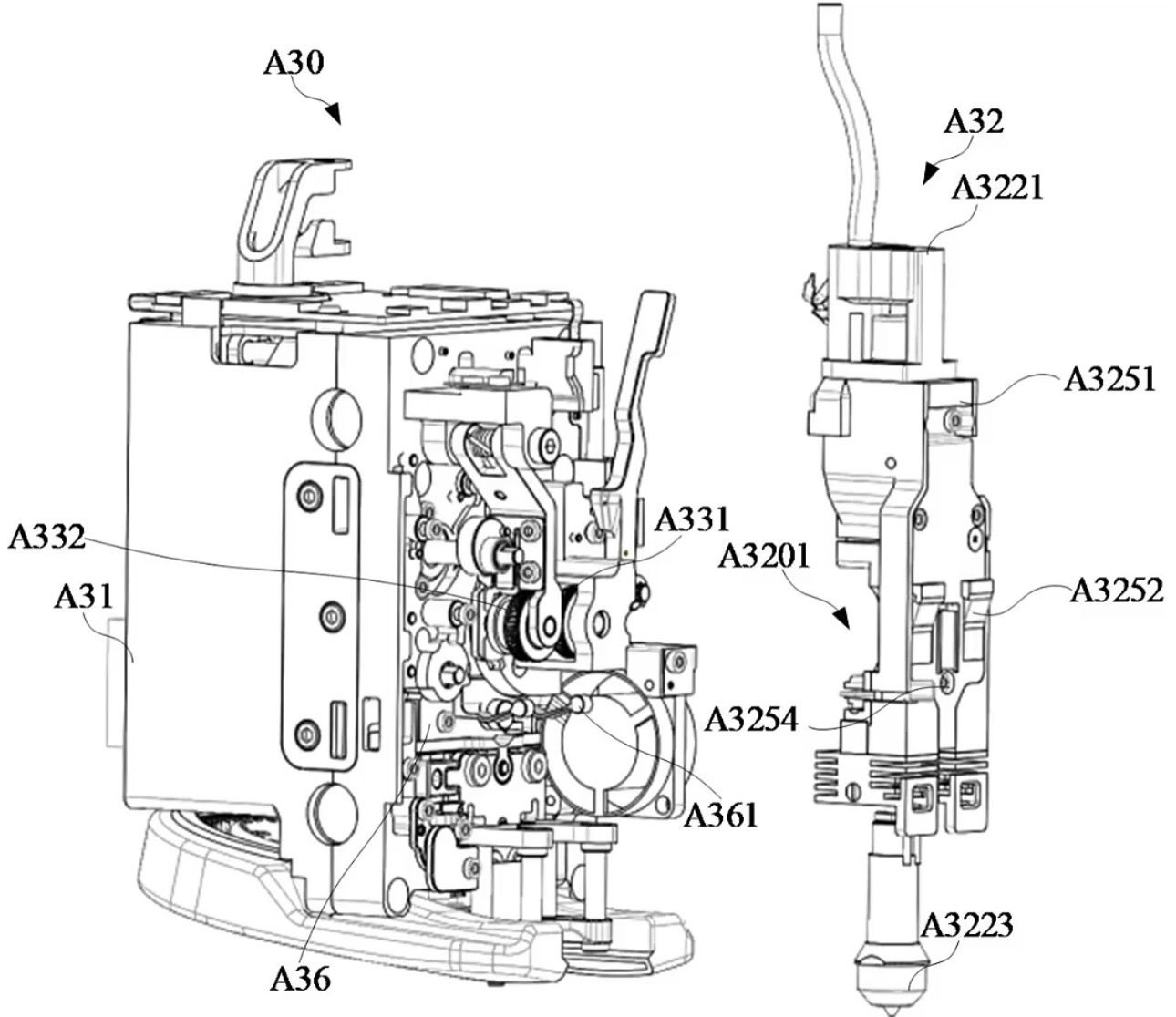
The gear pair that grips and pushes filament sits on the part that stays behind. The part that travels to the rack carries the filament path, the heat break, the heater and the nozzle. It has no drive gears of its own. On every swap, the machine re-threads the same extruder into a different melt zone.
That distinction is not academic. It is the whole reason the reporting went sideways.
Toolchanger or hotend changer
True toolchanger
Prusa XL, Snapmaker U1. The complete toolhead parks, extruder included. Each parked tool keeps its own filament loaded and ready, so a switch costs a docking move and nothing else. The price is duplication: every tool needs its own extruder and motor.
Hotend changer
Bambu Vortek in the H2C, and this patent. One extruder stays on the toolhead and only the melt zone below it is swapped. Lighter, simpler and cheaper to build, because the expensive part is not duplicated. The trade is that filament must be handled on every swap.
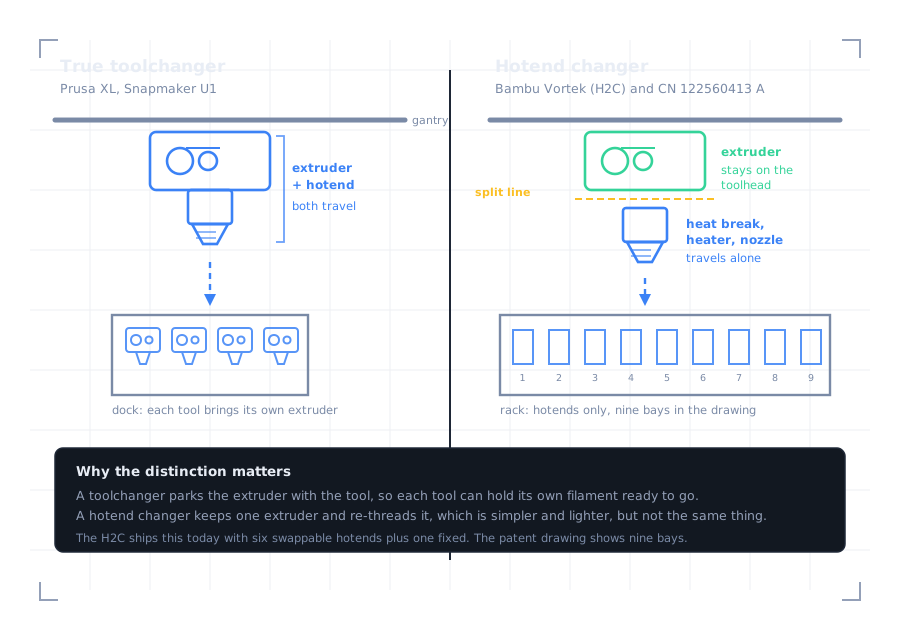
Bambu already sells the right-hand column. The H2C's Vortek system is a motorised rack of six induction-heated hotends next to one fixed hotend, giving seven dedicated melt zones per job. The patent describes that same architecture with more positions in the rack.
Nine bays, not ten
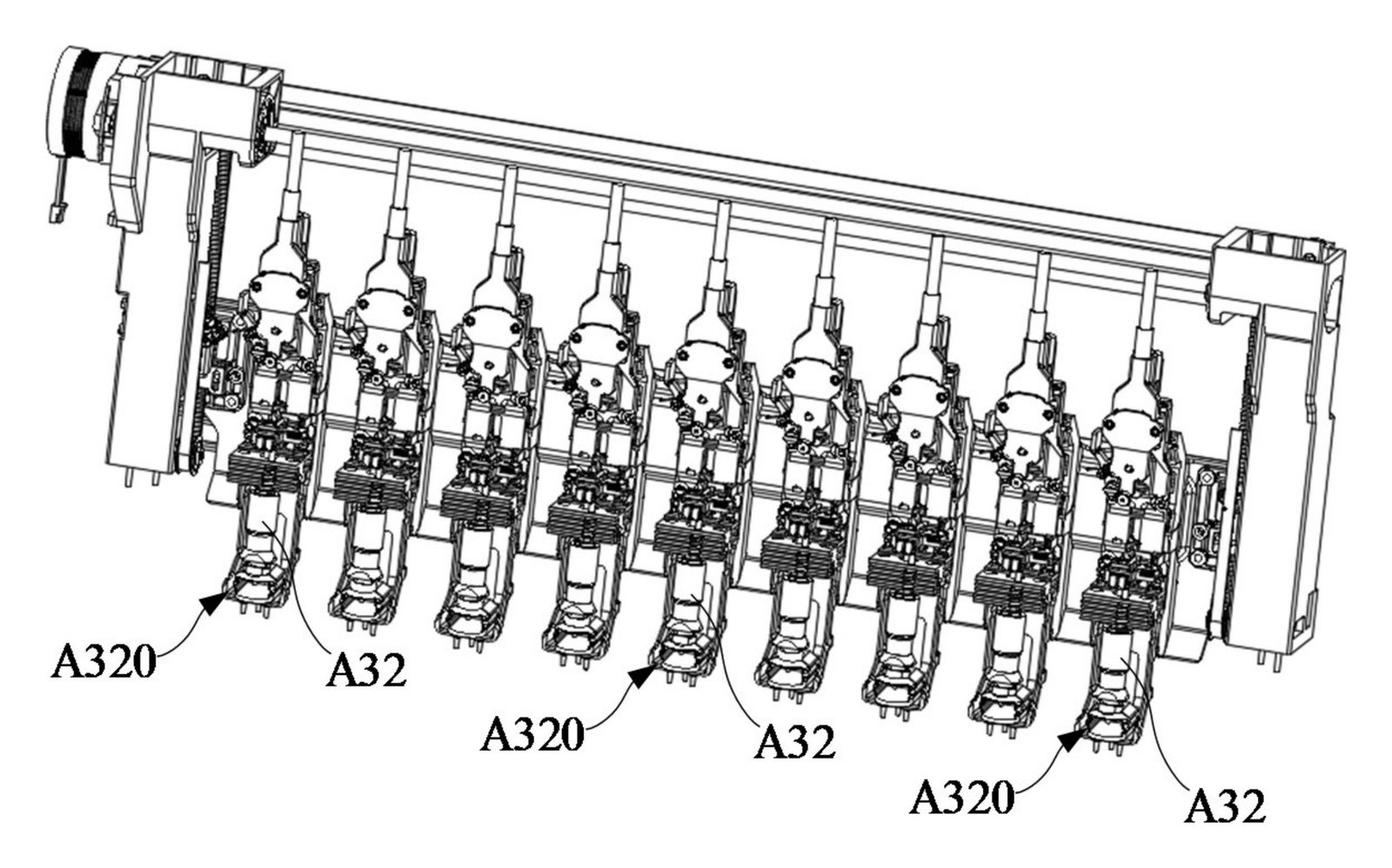
Count the filament tubes. There are nine, with the drive mechanism at the left end and the end plate at the right. The person who first published the drawings described it as a nine-head design, and the Bambu community forum thread is titled "Possible 9 Nozzle Toolhead Changer".
Several YouTube videos and a German forum thread nevertheless report ten. That number traces back to a single forum comment: "I count 10 tools and spools not 9." One reader's count became a video headline. In fairness, that comment says "tools and spools", so it may describe a different figure, but nothing we have seen supports ten.
Where this story came from
This is worth spelling out, because it explains why four sources agreeing means very little here.
The chain: CNIPA publishes the application on August 14. A private account on X, @BokuShumei, extracts the figures and posts them, describing a nine-head toolchanger and speculating that a machine could arrive by Christmas. Fabbaloo picks up the images. 3DPrintingIndustry, 3druck and 3DPCC follow. YouTube turns it into "10 hotends".
Fabbaloo, to its credit, says openly what the others do not:
At this time, I was unable to find a full copy of the patent in my usual sources; it is just that new. Fabbaloo, on the drawings it published
Every one of those articles rests on the same upstream source. When they agree, that is not four independent confirmations. It is one document passed along four times. Only 3DPCC shows detail suggesting first-hand access to the filing, such as the November 6, 2025 priority date and the component breakdown.
Two things got distorted on the way. The word "toolchanger", which the drawings contradict. And the Christmas timing, which was one person's guess written in the conditional, not a statement from Bambu. We made a comparable mistake ourselves in August, when we treated a secondary report of R1 specifications as a schedule. Bambu had never given a date.
What we do not know
The claims text. We can describe the mechanism because the drawings show it, but we cannot tell you what Bambu is actually seeking protection for, which is a different question entirely. As of writing, the filing is not retrievable through Google Patents, Espacenet, WIPO Patentscope or lens.org. It is simply too recent, and we will update this article when it becomes available.
We also cannot tell you which machine this becomes, if any. Companies patent things they never ship. The patent names no model, no date and no price, and Bambu has said nothing.
Bottom line
Bambu is working on a larger hotend rack: nine bays against the seven melt zones the H2C manages today, built on the architecture it already sells rather than a new one. That is a real step, and a smaller one than "Bambu is building a toolchanger" suggests.
If you are holding out for a machine, remember that a patent application is not a roadmap. If you want low-waste multi-material capability today, the H2C is the machine that has it, and our Vortek explainer covers how it works.
Sources
- CN 122560413 A, applicant Shenzhen Tuozhu Technology, published by CNIPA on August 14, 2026. Priority date November 6, 2025 (per 3DPCC). Figures circulated by @BokuShumei on X; the full filing was not retrievable through Google Patents, Espacenet, WIPO Patentscope or lens.org at the time of writing.
- CN 122560409 A, same applicant and publication date: illumination integrated into the part cooling ducts for camera-based extrusion monitoring. A separate invention, frequently pictured alongside the rack patent.
- 3DPCC, "Bambu Lab Patent Shows a Nine-Bay Hotend Rack", the only report with component-level detail.
- Fabbaloo, "Multi-Printhead Toolchanger Concept Beyond Vortek", source of the "beyond Vortek" framing.
- 3D Printing Industry, "Bambu Lab patents detail automatic printhead changing and nozzle monitoring systems".
- Bambu Lab community forum, "Possible 9 Nozzle Toolhead Changer", origin of the ten-bay count.
- H2C and Vortek specifications: our own H2C explainer, verified against the Bambu Lab store and wiki.