What Is the Bambu Lab H2C?
Published · Product explainer · Last updated:
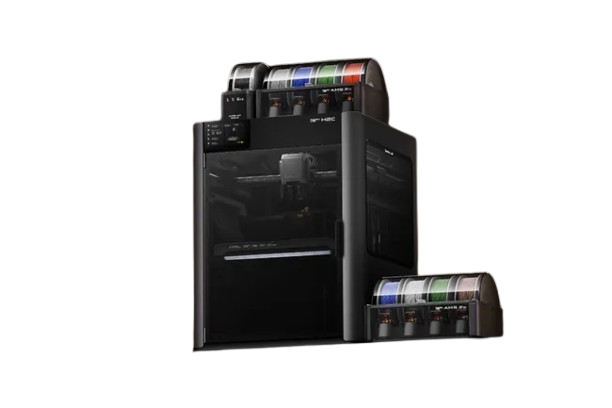
Short version
The H2C is Bambu's answer to the oldest annoyance in multi-material printing: purge waste. It is a dual-hotend H-series machine (same bones as the H2D) plus the Vortek system: a motorized rack holding six swappable induction-heated hotends next to one fixed hotend, so a single job can run seven dedicated melt zones and up to 25 colors with almost nothing purged into a waste pile. Launched at Formnext in November 2025, shipping since, currently $2,199 (list $2,399) in the US store and about 2,149€ in the EU. It is the most specialized printer Bambu sells, and most people don't need it; the ones who do, know exactly why.
Where it sits in the H series
Bambu's own shorthand for the H2 line is a clean three-step ladder. All three share the industrial enclosure, active 65°C chamber, 350°C temperatures and 1,000 mm/s motion system; they differ in how many melt zonesA melt zone is one hotend's heated path (heat block + nozzle), the part that actually melts filament. One hotend = one melt zone. they bring to a job.
| H2S | H2D | H2C | |
|---|---|---|---|
| Nozzle system | Single hotend | Dual hotend (independent) | Dual hotend + Vortek rack |
| Dedicated melt zones per job | 1 | 2 | 7 (1 fixed + 6 swappable) |
| Build volume | 340 × 320 × 340 mm | 350 × 320 × 325 mm | 305 × 320 × 325 mm |
| Street price | $1,199 $1,249 | $1,549 $1,749 | $2,199 $2,399 |
| Best for | Engineering materials, one at a time | Two-material work, soluble supports | True multi-material production |
Note the build volume: the headline "305 mm" is the right-hotend single mode. Bambu's own mode table shows the full picture: 325 mm wide on the left hotend, 330 mm in dual-combined mode (the H2D manages 350 combined), so the Vortek rack costs about 20 mm of combined X-width, not the 45 the headline specs suggest. The heated bed is slightly smaller too, which has a practical consequence we cover in "before you buy".
How Vortek actually works
The clever part is not the rack, it is the heating. Conventional hotends connect to the printer with electrical pins: heater cartridge, thermistor wires, a plug. Pins and plugs are exactly what you do not want on a part that gets swapped robotically hundreds of times. So Bambu removed them entirely.
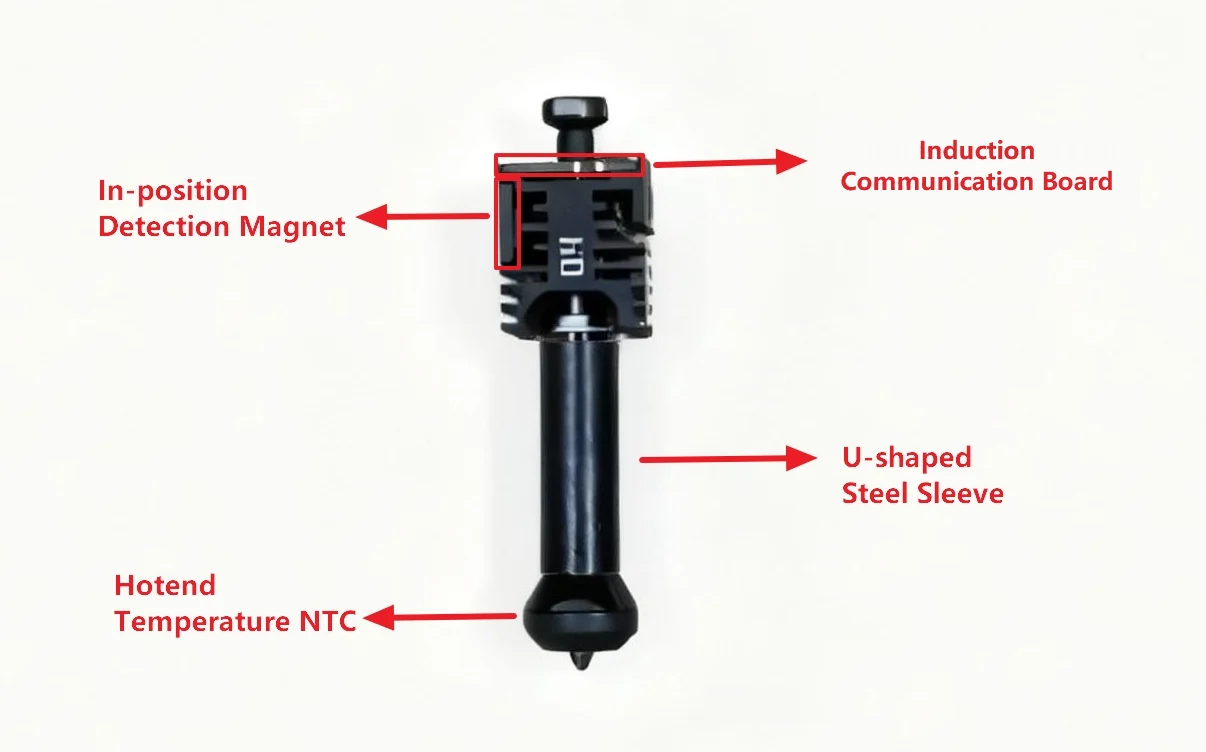
Each Vortek hotend is a sealed, contact-free module. Heating happens by electromagnetic induction: a drive coil on the toolhead generates a high-frequency alternating magnetic field, a magnetic core guides it into a U-shaped steel sleeve on the hotend, and eddy currents heat the steel directly, the same physics as an induction cooktop. Temperature data flows back the same contactless way, through an induction communication board on the hotend that talks to a receiver on the toolhead, no pins, no connectors, no wear.

The six spare hotends live on a motorized two-row rack at the back of the build chamber. When the job calls for a material change, the toolhead drives over, drops its current Vortek hotend into a free slot (a latch mechanism locks and releases automatically), picks up the next one, and resumes. The rack self-locates with magnet-based homing so the handoff stays precise. The seventh melt zone is the fixed left hotend, a standard H-series hotend (the same type the H2D and H2S use, available in standard flow, high flow and tungsten-carbide versions), which typically runs your primary material full-time.
To be precise about what "7" means: only two hotends are active on the toolhead at any moment (left and right, like the H2D). The right position is the one Vortek swaps. So the H2C does not print seven materials simultaneously; it gives one job access to seven dedicated melt zones, each material keeping its own.
Why dedicated melt zones matter
Single-nozzle multicolor, the way an AMS on a P1S or X2D works, has one unavoidable cost: every material change pushes the previous filament out through the same melt zone. That purged material lands in a waste chute or a purge tower, and on complex multicolor prints it can add up to a substantial share of the filament used. It also means materials share a nozzle: printing support material, TPU or PA through the same melt zone as your PLA invites cross-contamination and clogs.
Vortek sidesteps both problems structurally. Each material keeps its own hotend, so there is nothing to purge out and nothing to contaminate. Rigid plus flexible plus soluble support in one job, each through its own dedicated melt zone, is the workflow the H2C was built for. The H2D already does this for two materials with its independent dual nozzles; the H2C extends it to seven.
Vortek vs AMS: not competitors
The AMS still does the filament storage and feeding on an H2C, up to 4× AMS 2 Pro plus 8× AMS HT (12 units, 24 slots). Vortek decides which melt zone the filament goes through. First-generation AMS units work too (without drying); the AMS lite is not supported.
Variants, price, and what shipping looks like
The H2C sells in two versions. The laser version ships with 10W and 40W laser support built around a factory-integrated air pump, a top-view camera and laser-safe glazing, plus the cutting module. The non-laser version supports the cutting function only, and can be upgraded later with the same laser upgrade kit the H2D uses (with an external air pump instead of the built-in one).
Pricing has been stable since launch on our daily price tracker: $2,199 street against a $2,399 list price in the US (an open-ended discount with no announced end date) and around 2,149€ in the EU store. For context, that is $650 above the H2D and $1,000 above the H2S.
Before you buy: three things owners should know
- The H2C needs its own build plates. Because the Vortek mount shrinks the heated bed slightly, H2D/H2S/P-series plates do not fit. Budget for H2C-dedicated plates; the vision encoder, laser platform and cutting mat are shared across the H2 series.
- H2D and H2S owners can upgrade, but probably shouldn't. Vortek upgrade kits exist (shipping since early 2026), and Bambu's own FAQ recommends buying an H2C directly instead: the retrofit effectively swaps the entire X-axis assembly including the toolhead, demands real technical skill, and ends up costing more than the price difference.
- Routing got smarter in 2026. The June 2026 firmware (01.02.00.00) laid the groundwork for the Filament Track Switch, and the module is now shipping at $59.99, supporting the X2D, H2D and H2C. It releases the fixed binding between AMS units and nozzles, so filaments are no longer locked to the left or right feeding path. Whether it is worth buying depends heavily on how many AMS units you run: see our Filament Track Switch explainer for the limits Bambu does not advertise. Current firmware on our firmware tracker.
Who it's for, honestly
The H2C makes sense if
- You run multi-material jobs regularly: rigid + flexible + soluble support in one part
- Purge waste is real money in your workflow, not an annoyance
- You mix materials that should never share a melt zone (PA, TPU, support)
- The printer earns income: studio, small-batch production, engineering prototyping
Skip it if
- Your multicolor is decorative PLA: an AMS-equipped printer does that for a third of the price, purge waste and all
- Two materials per job cover you: the H2D does dual-material for $650 less, with more build volume
- You want maximum H-series volume for single-material engineering work: that is the H2S at $1,199
That is the honest read: the H2C is not "the best Bambu printer", it is the most specialized one. For the overwhelming majority of buyers the P2S, H2S or X2D/H2D answer the question better. But if your work is genuinely multi-material, nothing else in Bambu's lineup, and little else at this price anywhere, does what the Vortek system does.
Sources: Bambu Lab Wiki for the H2C, "Vortek Workflow and Function Introduction", "Induction Hotend Introduction", "Induction Hotend Rack Introduction" and the official H2C FAQ (all checked July 23, 2026) for the Vortek mechanics, melt-zone/AMS/color limits, plate compatibility, variant details and upgrade-kit guidance; announced at Formnext November 2025 per Bambu's launch communications. US/EU pricing from our daily price tracker (Bambu store JSON-LD, checked July 23, 2026). Hotend detail photo and swap animation from the Bambu Lab Wiki (Vortek documentation). Figures can change; check the official store and wiki before purchase decisions.